

News and Events
Fiber Optic Cabling Philippines: Enabling High-Speed Connectivity for Modern Businesses
What Is Fiber Optic Cabling?
Fiber Optic Cabling Philippines uses thin strands of glass or plastic to carry data as light rather than electrical signals. This makes fiber suitable for businesses that need fast data transfer, long-distance connections, and dependable performance across large or complex facilities.
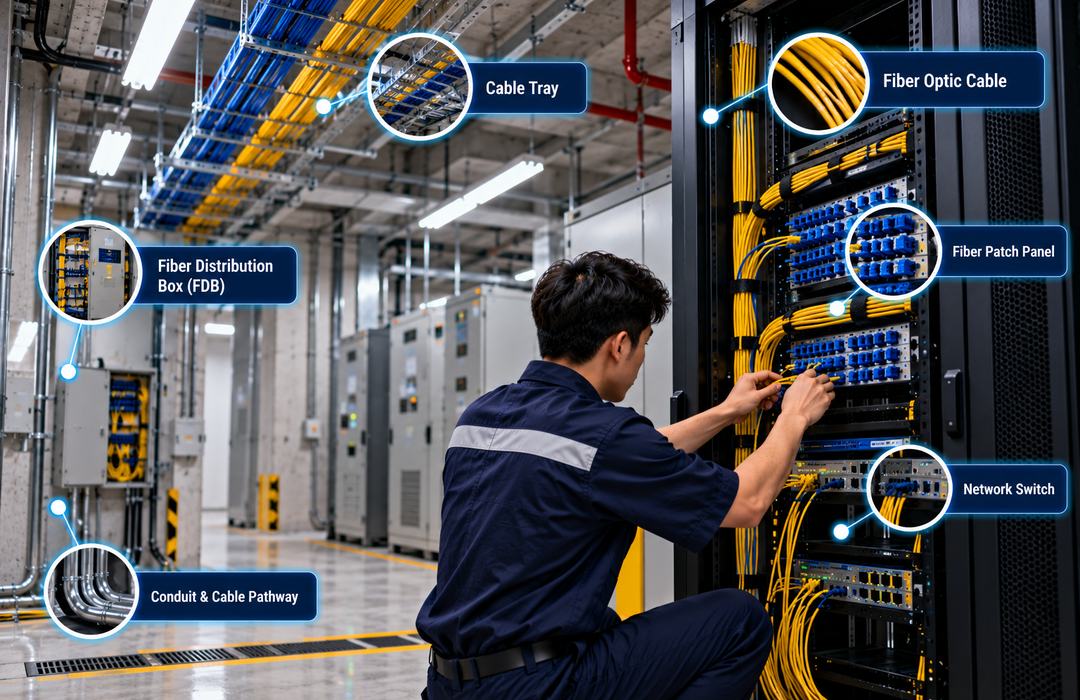
Fiber is commonly used to connect network switches, servers, buildings, telecommunications rooms, wireless systems, CCTV, and other network-based technologies. Because the signal travels through light, fiber is not affected by electromagnetic interference in the same way copper cabling can be.
The type of fiber matters. Glass fiber is commonly used for high-speed and longer-distance network links, while plastic optical fiber is generally more suited to shorter distances and applications where flexibility and easier handling are useful.
Foxcon Total Solutions, Inc. provides Fiber Optic Cabling for offices, industrial facilities, schools, healthcare facilities, data centers, and other organizations that need dependable network infrastructure.
Why Choose Fiber Optic Cabling?
One of the main reasons businesses use fiber is capacity. Fiber can carry large amounts of data, making it suitable for networks that support cloud applications, video conferencing, IP cameras, servers, wireless access points, and other systems that generate continuous traffic.
Distance is another advantage. Fiber can maintain useful signal performance over longer links than standard copper Ethernet, which makes it practical for campuses, large buildings, warehouses, and connections between separate facilities.
Fiber is also useful in environments with a lot of electrical equipment. Because optical transmission does not rely on electrical signals, it is resistant to electromagnetic interference that can affect copper connections.
This does not mean fiber should replace copper everywhere. The better choice depends on distance, speed, equipment, installation conditions, and cost. In many facilities, copper handles shorter device connections while fiber forms the backbone between network rooms, floors, or buildings.
How Fiber Optic Cabling Works
A fiber optic cable contains a core that carries light and a surrounding layer that helps keep that light traveling through the fiber. Data from network equipment is converted into optical signals before being sent through the cable.
At the other end, compatible equipment or a transceiver converts the optical signal back into data the network can use. This allows switches, routers, servers, and other devices to communicate across the fiber link.
Fiber installations can use different cable and connector types depending on the application. Single-mode fiber is typically chosen for longer-distance links, while multimode fiber is often used for shorter high-speed connections within buildings or data centers.
Plastic optical fiber works on the same basic principle of transmitting light through a core, but its material and performance characteristics make it more appropriate for selected short-distance uses rather than the long-distance backbone applications commonly handled by glass fiber.
Fiber Optic Cabling Safety & Trust
Fiber is durable when installed properly, but it still needs careful handling. Tight bends, crushed cable, poor termination, dirty connectors, or excessive pulling during installation can affect signal quality.
Connector cleanliness is especially important. A small amount of dust or contamination at the connection point can interfere with the optical signal, which is why fiber links should be inspected and cleaned using appropriate methods when needed.
The cable route should also match the environment. Indoor, outdoor, backbone, industrial, and other installations may require different cable construction or protection. Testing after installation is important because it confirms whether the completed link performs as expected. Results should be documented so future troubleshooting does not start from guesswork.
Foxcon Total Solutions, Inc. can support fiber projects through planning, cable installation, termination, splicing, testing, certification, network integration, and technical support.
Fiber Optic Cabling Tips
-
Choose fiber based on distance and network requirements instead of using one type for every application.
-
Plan backbone routes before equipment rooms and network cabinets are finalized.
-
Avoid tight bends and unnecessary tension during installation.
-
Keep connectors clean and protected when they are not in use.
-
Label both ends of every fiber link clearly.
-
Leave suitable spare capacity where future network growth is expected.
-
Test completed links before project turnover.
-
Keep fiber routes and test results documented for future maintenance.
-
Use appropriate protection where cables pass through industrial, outdoor, or exposed areas.
Use Fiber Where Distance and Capacity Actually Matter
Fiber optic cabling works best when it solves a real network requirement.
A company connecting two buildings may need fiber because the distance is too great for a standard copper link. A data center may choose fiber because multiple high-speed connections need to move large amounts of information between network equipment. An industrial facility may use it because electrical interference makes copper less practical in certain areas.
The important point is that fiber should be selected based on the application rather than treated as the automatic answer for every network connection.
A site assessment can determine where fiber makes sense, which fiber type is appropriate, how many strands are needed, where equipment should be placed, and how much capacity should be reserved for expansion. That planning helps businesses avoid both underbuilding the network and spending unnecessarily on infrastructure they do not need.
Frequently Asked Questions
What is Fiber Optic Cabling?
Fiber Optic Cabling is a communication system that uses light signals to transmit data through optical fibers. It provides high-speed, reliable connectivity for business networks, communication systems, and other digital technologies.
What are the advantages of Fiber Optic Cabling over copper cables?
Fiber optic cables offer higher bandwidth, longer transmission distances, and strong resistance to electromagnetic interference compared with traditional copper cables.
Where is Fiber Optic Cabling commonly used?
Fiber Optic Cabling is commonly used in office buildings, data centers, hospitals, schools, industrial facilities, commercial complexes, telecommunications networks, and other environments requiring high-speed connectivity over longer distances.
Can Fiber Optic Cabling support other building technologies?
Yes. Fiber Optic Cabling can support CCTV systems, Access Control Systems, Building Management Systems (BMS), Audio Visual Solutions, wireless networks, cloud services, and other IP-based technologies through the network infrastructure.
How long does Fiber Optic Cabling typically last?
When properly installed and protected, fiber infrastructure can remain usable for many years. Its practical service life depends on cable quality, installation conditions, physical protection, connector condition, and whether the infrastructure continues to meet the organization’s bandwidth requirements.
Why is preventive maintenance important for Fiber Optic Cabling?
Routine inspections, connector cleaning, link testing, and proper documentation help identify physical damage, contamination, or connection problems before they begin affecting network performance.
Upgrade to High-Speed Fiber Connectivity
Support faster and more scalable network connections with professionally installed Fiber Optic Cabling. Whether you need backbone cabling, fiber termination, splicing, testing, or network expansion, Foxcon Total Solutions, Inc. can help develop fiber infrastructure suited to your facility.
📞 Contact us today to discuss your fiber optic cabling requirements.
📍 Serving businesses in Cebu, Metro Manila, and nationwide.
🌐 Explore Foxcon’s solutions to learn more about our services.
References
-
Winsure IoT – Cables and Fiber Optic Products
https://www.winsureiot.com/product-category/cables/ -
PFOCN – Fiber Optic Network Solutions
https://pfocn.com/ -
VastResult – Fiber Optic and UTP Structured Cabling
https://vastresult.com/fiber-optic-utp-structured-cabling/ -
FibreTX – Plastic Optical Fiber Cable
https://www.fibretx.com/plastic-optical-fiber-cable/ -
Winsure IoT – Cables and Fiber Optic Products
https://www.winsureiot.com/product-category/cables/