


News and Events
CCTV Surveillance Systems Philippines: Improving Security Through Clearer Video Monitoring
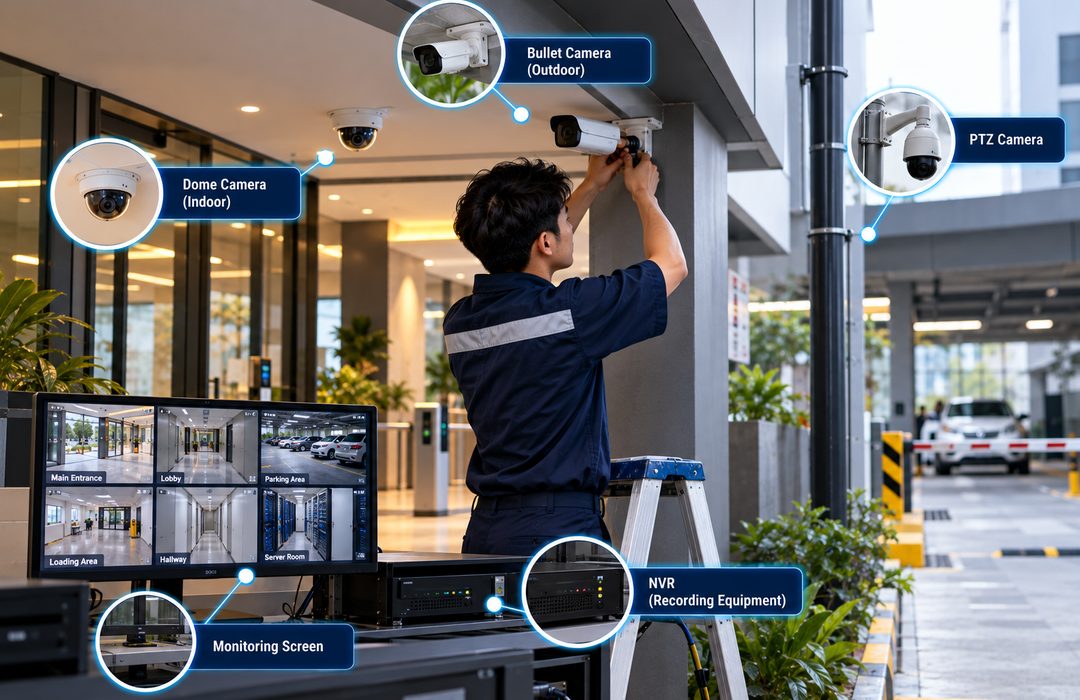
What Are CCTV Surveillance Systems?
CCTV Surveillance Systems Philippines uses cameras, recording equipment, and monitoring software to help organizations watch important areas, review incidents, and maintain visibility across their facilities.
A commercial CCTV setup can include fixed cameras, dome cameras, PTZ cameras, Network Video Recorders, storage devices, monitoring screens, and video management software. The equipment selected depends on the size of the property, lighting conditions, viewing distance, and the areas that need coverage.
Modern systems can also support remote viewing and event alerts, allowing authorized personnel to check live or recorded footage without staying in one control room.
Foxcon Total Solutions, Inc. provides CCTV Surveillance Systems for offices, warehouses, manufacturing facilities, hospitals, schools, hotels, retail properties, government offices, and other commercial environments.
Why Choose CCTV Surveillance Systems?
Cameras give security teams information they cannot get from alarms alone. An alarm may indicate that something happened, but video can help show who was involved, where the event occurred, and what happened before and after it.
This makes CCTV Surveillance Systems useful for monitoring entrances, parking areas, loading zones, hallways, storage rooms, production areas, and other locations that may be difficult to supervise continuously.
Recorded footage can also support incident reviews. Security teams can check access concerns, workplace incidents, property damage, visitor activity, or other events instead of relying only on witness accounts.
CCTV becomes more useful when it works alongside other security systems. An access control event or intrusion alarm can be checked against nearby video so personnel can verify what is happening before deciding how to respond.
How CCTV Surveillance Systems Work
The process begins with camera placement. Each camera should cover a specific area or security concern. Entrance cameras may focus on people arriving, while parking cameras need a wider view. Cameras in warehouses or industrial areas may require different lenses or mounting positions because of longer distances and changing light.
The camera sends video to recording or management equipment through network connections or dedicated cabling. In IP-based systems, video can be sent through the network to a Network Video Recorder or video management platform. Authorized users can then view live feeds, search recordings, export footage, or check selected cameras from compatible computers or mobile devices.
Storage capacity determines how much recorded footage can be kept. Retention time depends on the number of cameras, recording quality, frame rate, recording schedule, and available storage.
Some systems can also generate alerts based on motion or other configured events, helping security teams focus on activity that needs attention.
CCTV Surveillance Systems Safety & Trust
A camera is only useful when the footage clearly shows what security personnel need to see. Poor placement can leave blind spots, create excessive glare, or produce images that are too dark or distant to be useful. Camera height, angle, lighting, and field of view should therefore be checked during planning rather than adjusted only after installation.
Storage also needs careful planning. Recording at the highest quality on every camera may quickly consume available space, while settings that are too low can reduce the usefulness of recorded footage.
Access to surveillance footage should be limited to authorized personnel. User accounts, passwords, recording equipment, and network-connected cameras should be protected because CCTV systems may contain sensitive information about employees, visitors, and daily operations.
Routine checks should include image quality, camera position, recording status, storage health, date and time accuracy, software updates, and network connectivity. Foxcon Total Solutions, Inc. can support CCTV projects through assessment, camera planning, installation, network integration, testing, configuration, preventive maintenance, and technical support.
CCTV Surveillance Systems Tips
-
Give every camera a clear purpose before deciding where to install it.
-
Check entrances, loading areas, parking spaces, restricted rooms, and other locations where incidents are more likely to matter.
-
Test camera views during both daytime and nighttime conditions.
-
Avoid placing cameras where lights, windows, or reflective surfaces make identification difficult.
-
Review how long recorded footage needs to be kept before selecting storage capacity.
-
Restrict access to recordings and camera settings to authorized personnel.
-
Keep camera lenses clean and check whether devices have shifted from their original position.
-
Confirm that recording dates and times are accurate.
-
Test remote viewing and event alerts regularly if they are part of the system.
-
Review surveillance coverage whenever walls, entrances, work areas, or furniture layouts change.
Make Sure Recorded Footage Is Actually Useful
Installing more cameras does not automatically improve security. What matters is whether the footage can answer practical questions when an incident occurs.
If someone enters a restricted room, can the camera clearly show the doorway and the person involved? If a vehicle damages property in a parking area, is the camera positioned to capture useful details? If equipment goes missing from a warehouse, can security personnel trace movement through nearby areas?
These questions should influence camera placement more than simply trying to cover every possible corner.
A professional assessment can also help identify where one camera can serve several purposes and where separate views are necessary. The aim should be useful coverage, not the highest possible camera count.
Frequently Asked Questions
What is a CCTV Surveillance System?
A CCTV Surveillance System is a network of cameras, recording equipment, and monitoring software used to capture and manage video footage for security monitoring and incident investigation.
Where are CCTV Surveillance Systems commonly installed?
They are commonly installed in offices, warehouses, manufacturing facilities, hospitals, schools, hotels, shopping centers, parking areas, and government buildings.
Can CCTV Surveillance Systems be monitored remotely?
Yes. Many modern systems allow authorized users to view live video, review recordings, and receive alerts through secure desktop or mobile applications.
Can CCTV integrate with other security systems?
Yes. CCTV can integrate with Access Control Systems, Intrusion Alarm Systems, Visitor Management Systems, and other security technologies for centralized monitoring and faster event verification.
Why is preventive maintenance important for CCTV systems?
Preventive maintenance helps keep cameras clean, recording equipment functional, storage devices reliable, and software updated. It also allows technical issues to be identified before they affect surveillance coverage.
Bring Greater Visibility to Your Security Operations
Strengthen monitoring and incident awareness with professionally planned CCTV Surveillance Systems. From camera placement and recording infrastructure to network integration, testing, monitoring, and maintenance, Foxcon Total Solutions, Inc. can help build a surveillance solution for your property.
📞 Contact us today to discuss your CCTV surveillance requirements.
📍 Serving businesses in Cebu, Metro Manila, and nationwide.
🌐 Explore Foxcon’s solutions to learn more about our services.
References
-
Paessler – CCTV Explained
https://www.paessler.com/it-explained/cctv -
TP-Link Philippines – Cloud Cameras and Video Monitoring
https://www.tp-link.com/ph/home-networking/cloud-camera/ -
ResearchGate – Introduction to CCTV Surveillance Systems and Its Applications
https://www.researchgate.net/publication/399515707_INTRODUCTION_TO_CCTV_SURVEILLANCE_SYSTEMS_AND_ITS_APPLICATIONS -
CCTV Security Pros – What Is CCTV and How Does It Work?
https://www.cctvsecuritypros.com/articles/what-is-cctv-and-how-does-it-work/ -
National Protective Security Authority – CCTV and Video Surveillance
https://www.npsa.gov.uk/building-protection/video-surveillance-access-control-detection-control-rooms/cctv