


News and Events
Biometric Access Control Solutions Philippines: Strengthening Entry Security With Identity-Based Access
What Are Biometric Access Control Solutions?
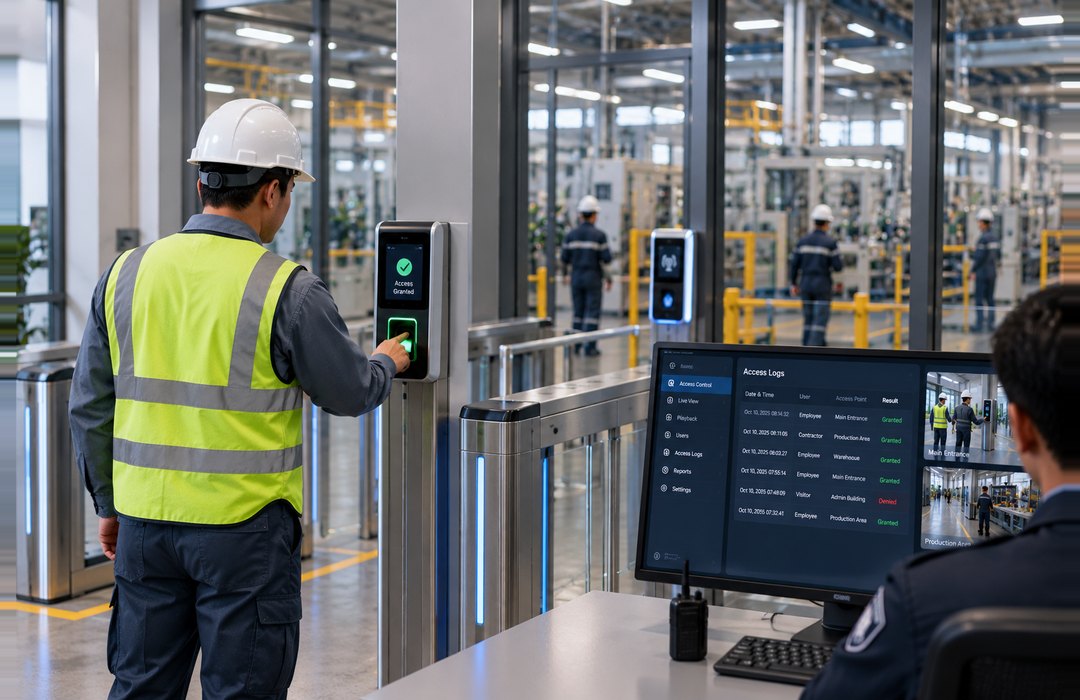
Biometric Access Control Solutions Philippines use physical or behavioral characteristics to verify a person’s identity before allowing access to a secured area.
Common biometric methods include fingerprint recognition, facial recognition, iris scanning, palm vein recognition, and hand geometry. Instead of relying only on something a person carries or remembers, such as a card or PIN, biometric systems verify characteristics associated with the individual.
These systems are often used in offices, data centers, hospitals, manufacturing facilities, schools, financial institutions, government buildings, and other locations where access to certain areas needs tighter control.
Foxcon Total Solutions, Inc. provides Biometric Access Control Solutions that can be planned around the facility’s security requirements, user volume, entry points, and existing access control infrastructure.
Why Choose Biometric Access Control Solutions?
Traditional access methods can be convenient, but they also have weaknesses. Keys can be copied. Cards can be lost or shared. PINs can be forgotten or disclosed.
Biometric authentication can reduce some of these risks by requiring the person attempting to enter to present a biometric characteristic that matches an enrolled user. This can be useful for areas where organizations need stronger identity verification, such as server rooms, records areas, laboratories, restricted offices, control rooms, and other sensitive spaces.
Biometric systems can also simplify access administration in certain environments. Instead of issuing and replacing physical credentials for every access event, authorized users can be enrolled in the system and assigned permissions based on their roles.
However, biometrics should not automatically be treated as the best option for every door. The technology should be selected according to security level, privacy requirements, user volume, environmental conditions, and operational convenience.
How Biometric Access Control Solutions Work
A biometric access control system typically begins with enrollment. During enrollment, the user’s biometric characteristic is captured using a compatible reader or sensor. The system then creates a digital biometric template that represents identifying features extracted from the scan.
When the person later attempts to enter a protected area, the reader captures a new sample and compares it with the enrolled template. If the system determines that the match meets the configured threshold and the user has permission to access that location, the access control system can release the door.
If authentication fails or the user does not have access rights, entry remains locked, and the event can be recorded. The access control platform can also maintain logs showing details such as the user, door, date, time, and access result.
Depending on the design, biometric readers may work as the only credential or as one part of multi-factor authentication, such as requiring both a card and a fingerprint for higher-security areas.
Biometric Access Control Solutions Safety & Trust
Biometric information requires careful handling because it is different from an ordinary password. If a password is compromised, it can usually be changed. A person’s fingerprint or facial characteristics cannot simply be replaced.
Organizations should therefore understand how the selected system captures, stores, protects, and processes biometric information before deployment. Access to biometric records and system administration should be restricted to authorized personnel. Encryption and other security measures should be used where supported, and data retention should follow the organization’s privacy and security requirements.
Accuracy also matters. No biometric system is perfect. Authentication systems may produce false rejections, where an authorized person is not recognized, or false acceptances, where an incorrect match is made. System selection and configuration should therefore consider the security level required by the facility.
Environmental conditions can affect performance too. Dirt, gloves, lighting, camera position, damaged fingerprints, or other physical factors can influence some biometric technologies.
Foxcon Total Solutions, Inc. can support biometric access projects through assessment, system planning, installation, integration, testing, commissioning, preventive maintenance, and technical support.
Biometric Access Control Solutions Tips
-
Match the biometric method to the environment. Fingerprint, facial, iris, and palm-based systems perform differently depending on site conditions.
-
Use stronger authentication for sensitive areas. Consider combining biometrics with another credential where higher assurance is required.
-
Define access permissions carefully. Employees should only have access to the areas required for their roles.
-
Protect biometric information. Review how templates are stored, transmitted, and accessed.
-
Plan for authentication failures. Establish a secure alternative procedure for legitimate users who cannot be recognized.
-
Position readers correctly. Poor camera angles, lighting, dirt, or physical obstructions can reduce performance.
-
Review access logs regularly. Look for unusual denied attempts, repeated failures, or unexpected access times.
-
Remove inactive users promptly. Access should be updated when employees transfer roles or leave the organization.
-
Maintain readers and controllers. Clean sensors, update software, and test door hardware regularly.
Use Biometrics Where Stronger Identity Verification Is Actually Needed
One of the most common mistakes in access control is treating biometrics as an upgrade that should be installed everywhere. That is not always necessary.
A general office entrance may work well with cards or mobile credentials, while a server room or restricted records area may justify stronger identity verification. This is where biometric access becomes more valuable.
The organization can classify areas according to risk and then determine which doors need basic access control, which require biometric verification, and which may require more than one authentication factor. This approach can also reduce inconvenience.
If employees must use biometric authentication for every low-risk door, the system may become frustrating without providing meaningful additional protection. The better strategy is to apply biometric technology where the consequences of unauthorized access justify the added security and administration.
Frequently Asked Questions
What is a Biometric Access Control System?
A Biometric Access Control System verifies a person’s identity using characteristics such as fingerprints, facial features, iris patterns, or palm characteristics before allowing access to a protected area.
What biometric technologies are commonly used?
Common technologies include fingerprint recognition, facial recognition, iris scanning, palm vein recognition, and hand geometry. The appropriate method depends on the environment and security requirements.
Are biometric systems more secure than access cards?
Biometrics can provide stronger identity verification because a person cannot simply hand a fingerprint or face credential to someone else the way an access card can be shared. However, overall security still depends on system design, data protection, device quality, access policies, and maintenance.
Can biometrics be combined with an access card?
Yes. Some systems can use biometric verification together with cards, PINs, or other credentials to provide multi-factor authentication for sensitive areas.
Can Biometric Access Control integrate with other security systems?
Yes. Depending on compatibility, biometric systems can work with CCTV Surveillance Systems, Visitor Management Systems, door controllers, alarm systems, centralized security platforms, and Building Management Systems.
What happens if the biometric reader does not recognize an authorized user?
Organizations should establish a controlled fallback process, such as verification by security personnel or another approved credential, rather than bypassing security controls.
Why is preventive maintenance important?
Reader cleanliness, software updates, network communication, controller condition, door hardware, and database management can all affect authentication reliability. Regular maintenance helps keep the system working consistently.
Secure Sensitive Areas With Biometric Access
Improve control over restricted areas with professionally implemented Biometric Access Control Solutions. From biometric readers and door controllers to system integration, testing, and maintenance, Foxcon Total Solutions, Inc. can help create an access environment suited to your security requirements.
📞 Contact us today to discuss your biometric access control needs.
📍 Serving businesses in Cebu, Metro Manila, and nationwide.
🌐 Explore Foxcon’s solutions to learn more about our services.
References
1. Innovatrics – Automated Biometric Identification System (ABIS)
https://www.innovatrics.com/innovatrics-abis/
2. Gallagher Security – Introduction to Biometric Access Control
https://security.gallagher.com/en/Blog/An-Introduction-to-Biometric-Access-Control
3. Oloid – Biometrics Access Control: Definition, Types, Pros and Cons
https://www.oloid.com/blog/biometrics-access-control-101-definition-types-and-its-pros–cons
4. Avigilon – Biometric Access Control
https://www.avigilon.com/blog/biometric-access-control
5. Johnson Controls – Biometrics Access Control
https://www.johnsoncontrols.com/security/access-control/biometrics-access-control