


News and Events
Door Access Controller Systems Philippines: Managing Electronic Entry Across Commercial Facilities
What Are Door Access Controller Systems?
Door Access Controller Systems Philippines are electronic security solutions used to manage and control entry through designated doors in commercial, industrial, and institutional facilities. The controller acts as the decision-making component of the access system by receiving information from readers, credentials, door sensors, request-to-exit devices, and other connected hardware.
When a user presents a credential, the controller checks that information against configured permissions and determines whether the door should unlock. Credentials may include access cards, key fobs, PIN codes, mobile credentials, or biometric authentication, depending on the selected system and project requirements.
Door access controllers can support offices, hospitals, hotels, schools, warehouses, manufacturing facilities, government buildings, and other environments that require controlled entry.
Foxcon Total Solutions, Inc. provides access control and integrated security solutions that can support structured physical security environments.
Why Choose Door Access Controller Systems?
Traditional keys can provide basic physical security, but they become harder to manage as the number of doors, users, and restricted areas increases. Lost or copied keys may require locks to be replaced, while administrators have limited visibility into when specific doors were accessed.
Door Access Controller Systems Philippines allow organizations to assign permissions according to user roles, departments, schedules, security levels, or specific areas. If an employee changes responsibilities or leaves the organization, compatible credentials can be disabled or updated without replacing locks throughout the facility.
Electronic access systems can also record supported events such as granted access, denied attempts, door status changes, and other activity. These records can help authorized personnel investigate incidents, review access history, and understand how secured areas are being used.
Door access controllers can work alongside Biometric Access Control Solutions, Visitor Management Systems, CCTV Surveillance Systems, IP Camera Systems, Intrusion Alarm Systems, Intercom Systems, and broader Building Security Integration.
How Door Access Controller Systems Work
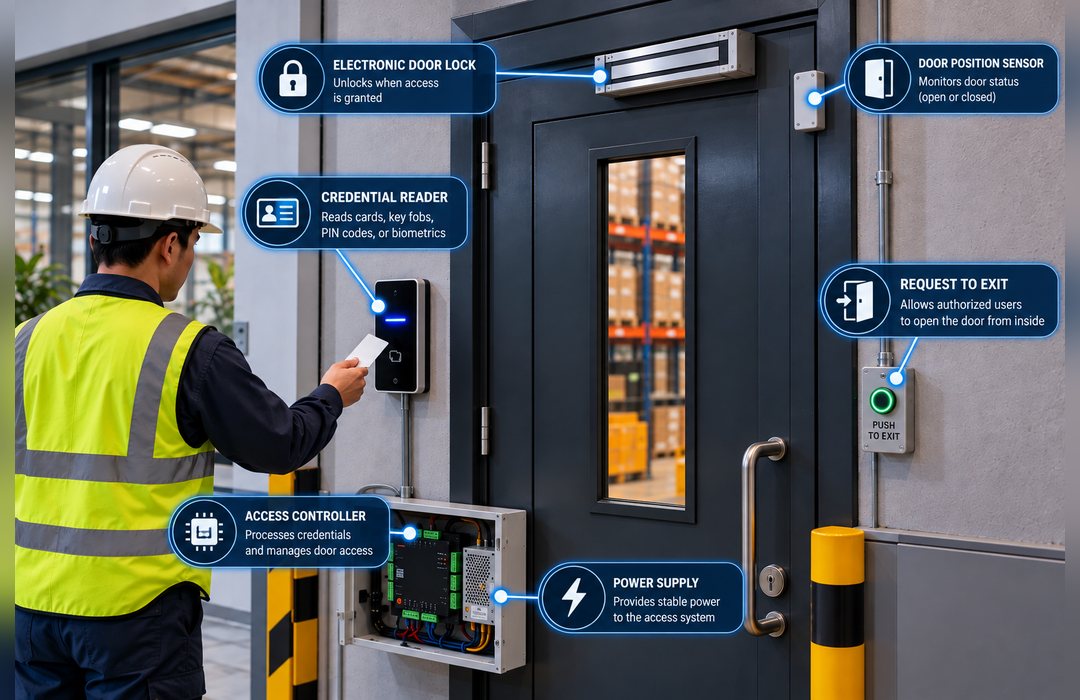
A typical controlled door may include an access controller, credential reader, electronic locking device, door position sensor, request-to-exit device, power supply, and management software. The exact combination depends on the security objective, type of door, locking hardware, and facility requirements.
When a credential is presented to the reader, its information is sent to the controller. The controller compares the credential with stored or centrally managed access permissions, including conditions such as the authorized door, user profile, and permitted schedule, then sends the appropriate command to the locking hardware.
The system can also monitor supported door conditions. For example, a door position sensor can indicate whether the door is open or closed, while software may record events such as forced-open conditions, doors held open longer than expected, or denied access attempts, depending on the configuration.
Controllers may support a single door or multiple access points. In larger facilities, multiple controllers can be connected to a centralized management platform so administrators can manage users, schedules, doors, credentials, and event records across the site.
Door Access Controller Systems Safety & Trust
Electronic access control must be coordinated with the building’s emergency and life-safety requirements. Security controls should not create unsafe egress conditions, and the behavior of electronic locks during fire alarms, power failures, or emergency situations should be defined as part of the system design.
Controllers, power supplies, communication equipment, and other critical components should be installed in protected locations where unauthorized personnel cannot easily disconnect or tamper with them. Network-connected controllers should also be secured through appropriate authentication, access restrictions, network segmentation, and system maintenance.
Administrative privileges require particular attention because access control software can determine who is allowed into restricted areas. User accounts, administrator roles, credential records, schedules, and system changes should be managed by authorized personnel and reviewed when staff responsibilities change.
Foxcon Total Solutions, Inc. supports security projects through Engineering and Design, Supply and Installation, Project Implementation, System Integration, Testing and Commissioning, Preventive Maintenance, and related technical services.
Door Access Controller Systems Tips
-
Define security zones before selecting hardware. Determine which areas require basic control and which require stronger restrictions.
-
Choose compatible components. Controllers, readers, locks, sensors, and software should be designed to work together.
-
Plan credential permissions carefully. Users should receive access only to areas required for their roles.
-
Protect the controller location. Critical access-control equipment should not be easily reachable from unsecured areas.
-
Restrict administrative privileges. Only authorized personnel should be able to add users or change access policies.
-
Review access rights regularly. Remove outdated permissions when employees transfer or leave.
-
Test door sensors and exit devices. Confirm that the physical door operates as intended, not just the credential reader.
-
Coordinate with CCTV where useful. Access events can provide better context when associated with compatible surveillance systems.
-
Include backup power where appropriate. Determine how controllers and locking hardware should operate during an outage.
-
Document door behavior during emergencies. Security and life-safety sequences should be clearly understood.
Test the Complete Door Sequence, Not Just the Card Reader
A credential reader can successfully recognize a card while the overall access point still fails to operate correctly. The controller, lock, door sensor, request-to-exit device, power supply, and door hardware all need to work together for the access point to function as intended.
Commissioning should therefore test both authorized and unauthorized access attempts. Technicians should confirm that valid credentials unlock the correct door, expired or unauthorized credentials are rejected, door status is reported correctly, and request-to-exit devices operate as designed.
Abnormal conditions should also be checked. Depending on the system, this can include a door being forced open, held open too long, loss of communication with the controller, power interruption, backup-power operation, or an emergency release command.
Testing the full sequence helps identify problems that may not appear during a simple credential scan. A reliable access control system depends on the complete interaction between electronic controls, physical door hardware, power, software, and the building’s operating requirements.
Frequently Asked Questions
What is a door access controller?
A door access controller is an electronic device that receives credential information, checks configured permissions, and determines whether access should be granted through a controlled door.
What credentials can Door Access Controller Systems use?
Depending on the selected technology, credentials may include cards, key fobs, PIN codes, mobile credentials, biometric authentication, or combinations of these methods.
Can one controller manage multiple doors?
Yes. Some controllers are designed for one door, while others can manage several access points. Larger installations may use multiple controllers connected to a centralized management platform.
Can door access controllers integrate with CCTV?
Yes, where compatible systems are used. Access events can be associated with camera views or recordings to provide additional context during investigation and monitoring.
What is a door position sensor?
A door position sensor reports whether a controlled door is open or closed. It can help the system identify conditions such as a forced-open door or one that has been left open longer than expected.
What happens during a power interruption?
Operation depends on the locking hardware, controller, backup-power configuration, and safety requirements. Some systems may use backup power, while lock behavior during outages should be defined during system design.
What is the difference between fail-safe and fail-secure locking?
The terms describe how certain electronic locking devices behave when power is removed. The appropriate configuration depends on the door function, security objective, emergency egress requirements, and applicable project requirements.
Should access permissions be reviewed regularly?
Yes. Regular reviews help ensure former employees, transferred staff, temporary personnel, or users with changed responsibilities do not retain unnecessary access.
Design the Door Around Both Security and Emergency Operation
A properly planned Door Access Controller Systems Philippines installation should do more than confirm whether a credential is valid. The controller, locking hardware, exit devices, sensors, power supply, software, emergency behavior, and user permissions should operate as one coordinated access point.
Foxcon Total Solutions, Inc. can support access-control planning, controller and reader integration, electronic locking infrastructure, system implementation, testing, commissioning, and preventive maintenance for commercial and institutional facilities.
📞 Contact us today to discuss your door access control and integrated security requirements.
📍 Serving businesses in Cebu, Metro Manila, and nationwide.
🌐 Explore Foxcon’s solutions to learn more about our services.
References
1. MySolutions Philippines – Access Control Solutions
https://www.mysolutions.com.ph/
2. Avigilon – Choosing the Best Door Access System
https://www.avigilon.com/blog/choosing-the-best-door-access-system
3. Verkada – Door Access Control
https://www.verkada.com/blog/door-access-control/
4. PhilSecurity – Access Control Systems
https://philsecurity.com/products/access-control.html
5. MySolutions Philippines – Security and Access Control Solutions
https://www.mysolutions.com.ph/