


News and Events
License Plate Recognition Systems Philippines: Improving Vehicle Access and Security Monitoring
What Are License Plate Recognition Systems?
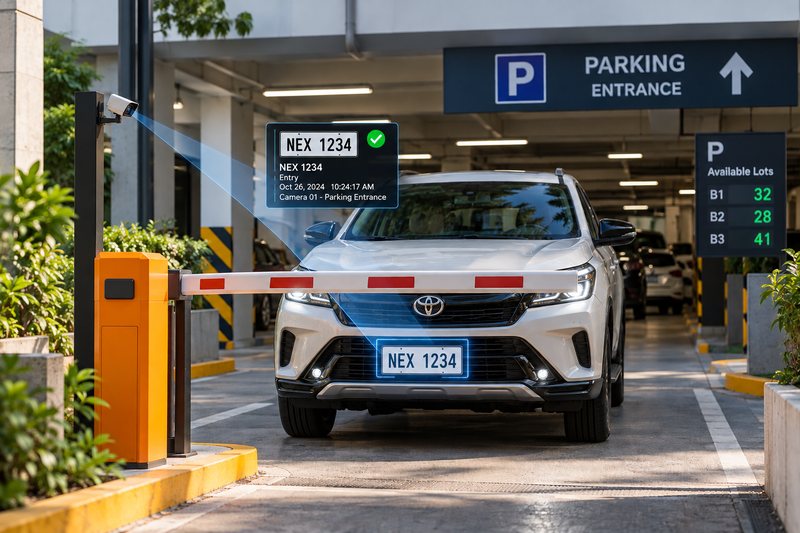
License Plate Recognition Systems Philippines are security and vehicle-monitoring solutions that use compatible cameras and recognition software to capture visible license plate information and convert it into searchable digital data. These systems are commonly referred to as LPR or ALPR, depending on the platform and application.
A typical LPR environment may include specialized cameras, recognition software, network infrastructure, recording equipment, storage, databases, and compatible access control or parking systems. Captured information can support vehicle monitoring, parking management, entry verification, investigations, and other security workflows.
LPR systems can be used in commercial buildings, industrial facilities, offices, residential developments, warehouses, campuses, parking facilities, and other locations with controlled vehicle access.
Foxcon Total Solutions, Inc. provides CCTV, IP camera, parking management, access control, and integrated security services that can support LPR deployments.
Why Choose License Plate Recognition Systems?
Facilities with frequent vehicle movement may need a more efficient way to identify vehicles and maintain records of entry and exit activity. Manual inspection alone can become difficult at busy gates, loading areas, parking entrances, and other access points where vehicles move continuously.
License Plate Recognition Systems Philippines can automatically capture visible plate information as vehicles pass designated monitoring points. The recognized plate number can be associated with details such as the image, camera location, date, and time, depending on the selected system.
Compatible platforms may also compare recognized plates against approved, denied, watchlist, or predefined vehicle records. This can support access workflows, parking operations, or security notifications without requiring personnel to manually check every vehicle.
LPR solutions can complement Parking Management Systems, CCTV Surveillance Systems, IP Camera Systems, Access Control Systems, Intelligent Video Analytics, and Building Security Integration.
How License Plate Recognition Systems Work
An LPR camera is positioned where it can capture approaching or departing vehicles under suitable image conditions. The camera records the plate area, and compatible software analyzes the image to identify and convert the visible characters into digital text.
The system may then store the recognized plate together with the original image, event time, camera location, lane, or other supported metadata. Security personnel can use this information to search previous vehicle events or review activity associated with a specific plate.
When integrated with parking or access control systems, the recognized plate can be compared against configured authorization records. Depending on the design, an approved match may support a predefined action such as opening a barrier, while a flagged plate may generate an alert for security personnel.
Recognition performance depends heavily on camera angle, mounting height, vehicle speed, lighting, plate visibility, shutter settings, lens selection, image quality, and the way the recognition software is configured. A successful LPR deployment therefore depends on both the software and the quality of the captured image.
License Plate Recognition Systems Safety & Trust
License plate information can form part of vehicle activity and security records, so access to stored data should be controlled appropriately. User permissions, administrative accounts, network access, retention periods, and export functions should be managed according to organizational policies and applicable privacy requirements.
Camera selection and placement are equally important. A standard surveillance camera may capture a general view of a vehicle but still fail to provide the image detail needed for reliable plate recognition, particularly at night, under glare, or when vehicles are moving quickly.
Network connectivity, recording infrastructure, storage, time synchronization, and system health should also be monitored. If recognition software is functioning but images are not being stored correctly, the organization may lose the supporting evidence needed to verify an event later.
Foxcon Total Solutions, Inc. supports security projects through Engineering and Design, Supply and Installation, Project Implementation, System Integration, Testing and Commissioning, Preventive Maintenance, and related technical services.
License Plate Recognition Systems Tips
-
Position cameras for plate capture. Do not rely only on general overview cameras.
-
Control the viewing angle. Excessive horizontal or vertical angles can reduce recognition accuracy.
-
Consider vehicle speed. Faster traffic may require different camera and exposure settings.
-
Plan for day and night conditions. Headlights, glare, shadows, and low light can affect image quality.
-
Use suitable lane coverage. Avoid expecting one camera to recognize plates across an excessively wide area.
-
Restrict access to vehicle records. Limit searches, exports, and administrative functions to authorized users.
-
Maintain accurate time settings. Correct timestamps are important when reviewing vehicle events.
-
Test under real traffic conditions. Daytime testing alone may not reveal nighttime recognition issues.
-
Review retention requirements. Define how long plate data and related images should remain available.
Capture the Plate Clearly Before Blaming the Recognition Software
When an LPR system produces inaccurate or inconsistent results, the recognition engine is not always the problem. Poor source images caused by excessive viewing angle, motion blur, glare, low light, incorrect focus, or insufficient plate size can prevent even capable software from reading the characters correctly.
Technical teams should therefore inspect the actual captured plate images before changing recognition settings or replacing software. The plate should be large enough in the image, reasonably sharp, properly exposed, and visible without excessive obstruction.
Nighttime conditions deserve particular attention because headlights and reflective license plates can create strong contrast. Suitable exposure, infrared illumination where supported, and appropriate camera positioning can help preserve readable plate detail instead of producing a bright reflective rectangle.
Improving the image at the point of capture often provides a more reliable result than repeatedly adjusting recognition thresholds around a poor-quality video source.
Frequently Asked Questions
What is a License Plate Recognition System?
A License Plate Recognition System uses compatible cameras and software to capture visible vehicle plates and convert the characters into searchable digital information.
Where can LPR systems be used?
They can be used at parking facilities, commercial buildings, industrial sites, residential developments, warehouses, campuses, offices, and other controlled vehicle areas.
Can LPR integrate with Parking Management Systems?
Yes. Compatible LPR platforms can be integrated with parking and vehicle access systems to support authorized-entry, monitoring, and parking workflows.
Is LPR the same as a regular CCTV camera?
No. General CCTV cameras are mainly intended for surveillance video, while LPR systems are designed and configured specifically to capture and process license plate information.
What factors affect recognition accuracy?
Vehicle speed, camera angle, mounting position, lighting, glare, image sharpness, plate visibility, lens selection, and system configuration can all affect performance.
Can LPR systems maintain vehicle records?
Yes, depending on the platform. Recognized plates may be stored together with images, timestamps, camera locations, and other supported event information.
Can a plate be used as an access credential?
In compatible systems, a recognized plate may be compared with an authorized vehicle list and used as part of a predefined access-control workflow.
Does LPR work at night?
It can, but nighttime performance depends on camera capability, illumination, exposure settings, vehicle headlights, reflective plates, angle, and installation conditions.
Test Recognition at the Actual Entry Speed
An LPR system may perform well when vehicles stop directly in front of a camera but produce weaker results when the same vehicles move through the lane at normal operating speed.
Testing should therefore reflect the way the entrance or roadway will actually be used.
During commissioning, vehicles should pass through the capture area at expected speeds and under different lighting conditions. The test should include common plate positions, different vehicle types, day and night operation, and any conditions that regularly occur at the site.
If recognition quality falls when vehicles move faster, the issue may involve shutter speed, lighting, camera angle, lens choice, or the distance between the vehicle and the camera. These conditions should be corrected before relying on the system for automated access decisions.
Real-world testing helps confirm whether the complete capture-and-recognition process works reliably instead of validating only the software interface.
Design the Capture Point Around the Vehicle Lane
A properly planned License Plate Recognition Systems Philippines environment should consider lane geometry, vehicle speed, lighting, camera placement, image quality, recognition software, data retention, access-control integration, and network infrastructure as one coordinated system.
Foxcon Total Solutions, Inc. can support LPR planning, CCTV and IP camera deployment, network infrastructure, parking and access-control integration, testing, commissioning, documentation, and preventive maintenance for commercial and institutional facilities.
📞 Contact us today to discuss your license plate recognition and vehicle-monitoring requirements.
📍 Serving businesses in Cebu, Metro Manila, and nationwide.
🌐 Explore Foxcon’s solutions to learn more about our services.
References
1. Pelco – License Plate Recognition
https://www.pelco.com/blog/license-plate-recognition
2. Survision – What Is License Plate Recognition?
https://survisiongroup.com/post-what-is-license-plate-recognition
3. Plate Recognizer – License Plate Recognition Solutions
https://platerecognizer.com/
4. Public Sector Network – Licence Plate Recognition: What It Is and How It Works
https://publicsectornetwork.com/insight/licence-plate-recognition-what-it-is-and-how-it-works
5. Scylla – Intelligent License Plate Recognition Systems
https://www.scylla.ai/8-reasons-to-use-intelligent-license-plate-recognition-systems/