


News and Events
Fire Detection System Integration Philippines: Coordinating Fire Safety Technologies Across Facilities
What Is Fire Detection System Integration?
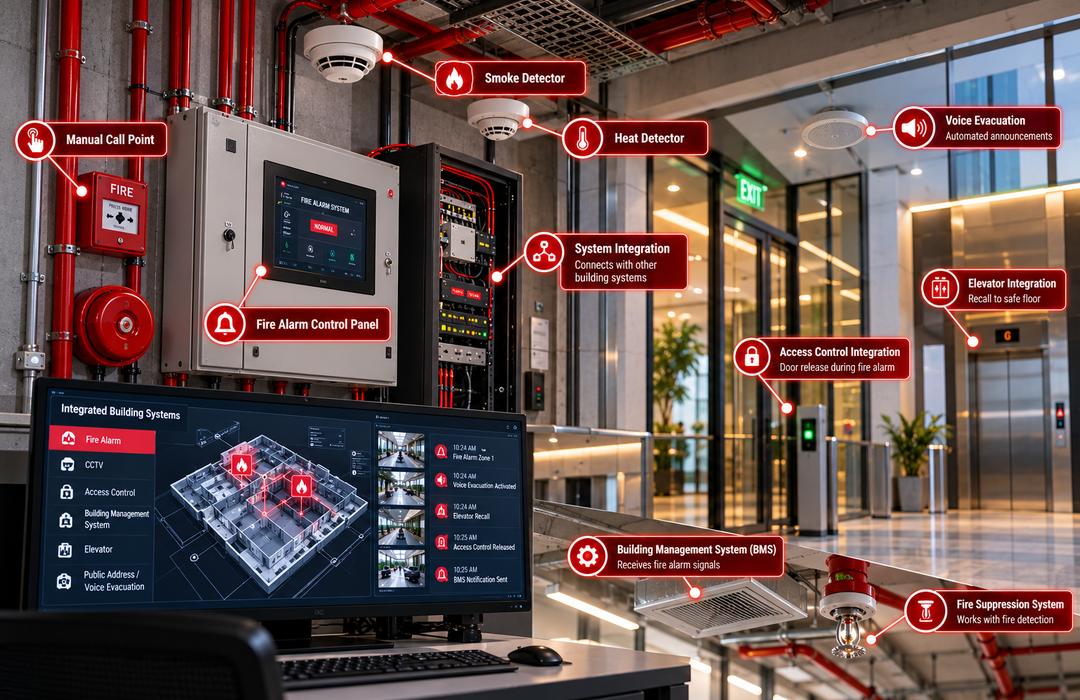
Fire Detection System Integration Philippines refers to the coordinated connection of fire detection and alarm technologies with other compatible building systems so that defined emergency signals and responses can work together.
A fire detection environment may include smoke detectors, heat detectors, manual call points, notification appliances, alarm control panels, interface modules, and other devices used to detect and communicate fire-related conditions.
Integration can allow compatible systems such as Voice Evacuation, Public Address, Building Management Systems, Access Control Systems, and selected building controls to receive or respond to fire alarm signals according to the approved project design.
Foxcon Total Solutions, Inc. provides fire detection, alarm, and building technology solutions that can support integrated fire safety environments for commercial, industrial, and institutional facilities.
Why Choose Fire Detection System Integration?
Large facilities often rely on several systems that may need to respond together during an emergency. If these technologies operate independently, security personnel, facility teams, and emergency responders may need to coordinate several actions manually.
Fire Detection System Integration can help automate selected responses. For example, a confirmed fire alarm condition may activate notification devices, start an approved voice evacuation message, send status information to a Building Management System, or initiate other predefined building responses where the system design allows it.
Integration can also improve operational visibility. Facility personnel may be able to see fire-related alarms, system status, or selected event information through compatible monitoring platforms without changing the core function of the dedicated fire alarm system.
The objective is not to make every building technology dependent on one platform. Instead, integration should support the approved emergency strategy while preserving the required operation of the fire detection system itself.
How Fire Detection System Integration Works
The process starts by defining the required cause-and-effect sequence. Technical teams identify what should happen when a detector, manual call point, sprinkler-related input, or other fire alarm condition is activated.
They then review:
-
Fire alarm panel capabilities
-
Input and output modules
-
Relays and interfaces
-
Communication protocols
-
Building Management System connections
-
Voice Evacuation interfaces
-
Access control interfaces
-
Elevator or other building-control interfaces where applicable
-
Network or software communication methods
-
Manufacturer requirements
Depending on the system, integration may use hardwired relays, supervised inputs and outputs, dedicated interface modules, supported digital communication, or manufacturer-approved software connections.
After configuration, the complete sequence should be tested. Testing should confirm that the original alarm is detected correctly and that every connected response occurs in the intended order.
Fire Detection System Integration Safety & Trust
Fire detection integration should be handled carefully because connected systems may perform critical functions during an emergency. The fire alarm system should remain the dedicated source of fire detection and alarm control unless the approved design specifies otherwise. A Building Management System or other monitoring platform may receive status information, but that does not mean it should replace the dedicated fire alarm control equipment.
Compatibility must also be confirmed before implementation. Not every fire alarm panel, access control platform, voice evacuation system, or BMS can communicate directly with every other technology. Integration methods should therefore follow manufacturer guidance, approved project requirements, and applicable fire safety standards.
Documentation is equally important. Cause-and-effect matrices, system diagrams, device locations, interface points, panel programming records, test results, and commissioning records should be maintained so future technicians can understand how connected systems are expected to respond.
Foxcon Total Solutions, Inc. supports projects through Engineering and Design, Supply and Installation, Project Implementation, Testing and Commissioning, Preventive Maintenance, and related technical services.
Fire Detection System Integration Tips
-
Define the cause-and-effect sequence early. Know exactly what each alarm condition should trigger.
-
Confirm compatibility before installation. Review panel interfaces, modules, protocols, and manufacturer support.
-
Keep life-safety functions independent where required. Do not make critical fire alarm operation unnecessarily dependent on non-life-safety platforms.
-
Document every integration point. Record inputs, outputs, relays, modules, and software interfaces.
-
Test complete emergency sequences. Verify more than just device activation.
-
Check message and alarm priorities. Emergency functions should take precedence where required.
-
Restrict programming access. Only authorized personnel should modify fire alarm logic.
-
Maintain connected systems together. A failed interface can affect the intended response even when individual systems remain operational.
-
Update records after changes. Modified panels, devices, or building systems may affect existing integration.
-
Retest after major upgrades. Replacement equipment can alter communication or control behavior.
Test the Entire Cause-and-Effect Sequence, Not Just the Alarm Device
A fire detection system can appear to work correctly even when an integrated response is not functioning as intended. Consider a fire alarm condition that is supposed to trigger several actions.
The alarm panel may successfully detect the event and activate local notification devices, but the Voice Evacuation System may fail to receive the signal, or a connected access control function may not respond as programmed.
Testing only the detector would not reveal those problems. A better commissioning approach is to test the complete sequence.
For example:
-
Activate the defined fire alarm condition.
-
Confirm the fire alarm panel receives and identifies it correctly.
-
Verify the required notification devices activate.
-
Confirm the intended voice evacuation message or communication response.
-
Check connected building-system signals.
-
Verify related control actions where required.
-
Confirm fault conditions and resets behave properly.
-
Record the result.
This type of testing helps identify problems in interfaces, programming, wiring, communication paths, and connected-system logic before the facility depends on them during an actual emergency.
Frequently Asked Questions
What is Fire Detection System Integration?
Fire Detection System Integration is the process of connecting compatible fire detection and alarm equipment with other building systems so defined signals and emergency responses can operate together.
What systems can integrate with a fire detection system?
Depending on compatibility and approved design, integrations may involve Voice Evacuation Systems, Public Address Systems, Building Management Systems, Access Control Systems, elevator interfaces, and other emergency-related building technologies.
Can existing fire detection systems be integrated?
Possibly. Existing panels and equipment should be assessed for available outputs, input modules, communication interfaces, software support, and compatibility with the proposed connected systems.
Does a Building Management System replace the fire alarm panel?
Generally, no. A BMS may receive fire alarm status or selected signals, but the dedicated fire alarm system should continue performing its required life-safety functions according to the approved design.
What is a cause-and-effect sequence?
A cause-and-effect sequence defines what actions should occur when a particular fire alarm event happens, such as activating notification devices, starting voice evacuation, or sending signals to connected systems.
What is tested during fire detection system integration?
Testing may include alarm activation, notification devices, interface modules, connected-system responses, communication links, control sequences, resets, and other functions defined by the project requirements.
Why is documentation important?
Documentation helps technicians understand how the fire alarm system interacts with other technologies and provides a reference for maintenance, inspections, troubleshooting, future upgrades, and recommissioning.
Design Every Integration Around the Approved Emergency Sequence
Support coordinated emergency response with professionally planned Fire Detection System Integration Philippines. From cause-and-effect planning and interface design to installation, programming, system integration, testing, commissioning, and maintenance, Foxcon Total Solutions, Inc. can help organizations connect fire detection systems with compatible building technologies around defined safety requirements.
📞 Contact us today to discuss your fire detection and building-system integration requirements.
📍 Serving businesses in Cebu, Metro Manila, and nationwide.
🌐 Explore Foxcon’s solutions to learn more about our services.
References
-
Group One Safety & Security – Integrated Fire Alarm Systems for Buildings
https://www.grouponesafetyandsecurity.com/integrated-fire-alarm-systems-buildings/ -
DMTech – Integration of Fire Alarm Equipment and Building Management Systems
https://dmtech-ltd.com/2026/02/05/integration-of-fire-alarm-equipment-and-building-management-systems-bms/ -
Advanced – How Fire Detection and Alarm Systems Work
https://www.advancedco.com/how-do-fire-detection-alarm-systems-work/ -
IJE AIS – Fire Detection and Alarm System Study
http://ijeais.org/wp-content/uploads/2025/8/IJEAIS250807.pdf -
BH Courses – Fire Alarm System Integration With Sprinklers, Access Control, and Other Systems
https://bhcourses.ie/info/fire-alarms-for-beginners-quick-guide/fire-alarm-system-integration-connecting-with-sprinklers-access-control-and-more