


News and Events
IP Camera Systems Philippines: Building Scalable Surveillance for Commercial Facilities
What Are IP Camera Systems?
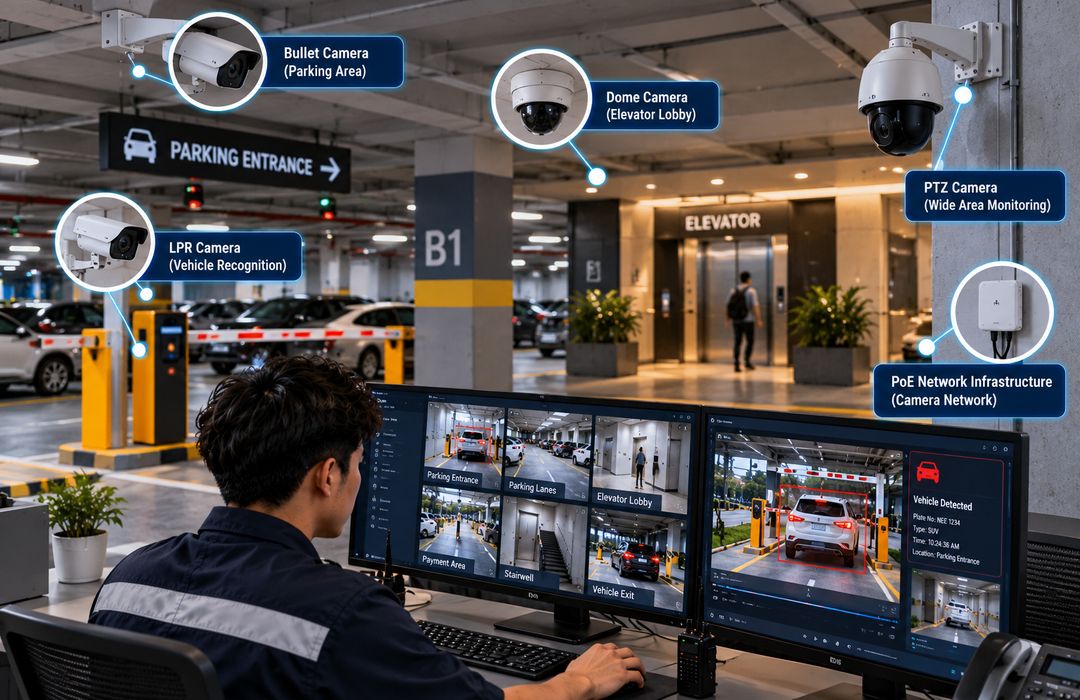
IP Camera Systems Philippines are digital surveillance solutions that capture video and transmit it through an Internet Protocol network for monitoring, recording, and management. Unlike traditional analog surveillance systems, IP cameras connect through compatible network infrastructure and can often be managed from centralized video platforms.
Depending on the camera and system design, features may include high-resolution video, remote viewing, motion detection, event notifications, recording schedules, low-light performance, and integration with compatible video analytics or security platforms.
Foxcon Total Solutions, Inc. provides IP Camera Systems that can support offices, warehouses, commercial buildings, industrial facilities, campuses, parking areas, and other environments requiring scalable video surveillance.
Why Choose IP Camera Systems?
Commercial facilities often need surveillance across multiple areas, including entrances, exits, corridors, workspaces, loading areas, parking zones, warehouses, and perimeter locations. As the facility expands, the surveillance system may also need to grow.
IP Camera Systems support this flexibility by using network-based infrastructure. Additional compatible cameras can usually be added when sufficient switch capacity, network bandwidth, storage, licensing, and recording resources are available.
Centralized management is another advantage. Authorized security personnel can monitor multiple camera feeds, review recorded footage, search for events, and manage user permissions through compatible surveillance platforms.
IP Camera Systems can also work alongside Access Control Systems, Intelligent Video Analytics, Integrated Security Management Systems, Network Infrastructure Solutions, and Command Center Display Solutions. When these technologies are planned together, security teams can gain a more coordinated view of facility activity.
How IP Camera Systems Work
An IP camera captures video through its image sensor and converts that footage into digital data. The video is then transmitted across a compatible IP network.
Cameras may connect to network switches through Ethernet cabling, while supported Power over Ethernet (PoE) systems can provide both network connectivity and electrical power through a single compatible Ethernet connection.
Video may be recorded using a Network Video Recorder, server-based recording platform, dedicated storage system, or Video Management System depending on the surveillance architecture. Authorized users can then access live or recorded video according to configured permissions.
Several technical factors affect overall system performance. These include:
-
Camera resolution
-
Frame rate
-
Video compression
-
Number of cameras
-
Recording schedules
-
Storage retention period
-
Network bandwidth
-
Available switch capacity
-
Video analytics processing
-
Remote viewing requirements
These elements should be considered together rather than choosing cameras independently from the network and storage infrastructure.
IP Camera Systems Safety & Trust
Because IP cameras are network-connected devices, cybersecurity should be part of the surveillance design. Default usernames and passwords should be changed during installation. Administrative accounts should be restricted to authorized personnel, and strong authentication practices should be used where supported.
Firmware and software should also be maintained appropriately. Updates may address security vulnerabilities, improve device stability, or maintain compatibility with the wider surveillance environment. Network segmentation can provide additional protection. For example, IP cameras may be placed on a dedicated VLAN or security network rather than sharing unrestricted access with ordinary business users.
Access to live footage, archived recordings, system configuration, and exported video should also be controlled according to user responsibilities. Physical placement requires similar care. Cameras should be positioned according to legitimate security requirements while considering workplace privacy, coverage objectives, lighting, viewing angles, and applicable organizational policies.
Foxcon Total Solutions, Inc. can support IP Camera System projects through site assessment, surveillance planning, network coordination, installation, configuration, integration, testing, commissioning, preventive maintenance, and technical support.
IP Camera Systems Tips
-
Define the surveillance objective first. Know whether each camera is intended for general observation, identification, perimeter monitoring, or another specific purpose.
-
Assess lighting conditions. Camera performance can change significantly between daylight, low-light, and backlit environments.
-
Calculate bandwidth before deployment. High-resolution cameras can place substantial demand on the network.
-
Plan storage around retention requirements. Camera quantity, frame rate, compression, and recording schedule all affect capacity.
-
Use PoE where appropriate. It can simplify power and network cabling for compatible cameras.
-
Segment surveillance traffic. Separating cameras from ordinary user networks can improve security and traffic management.
-
Restrict administrative access. Only authorized personnel should be able to change camera or recording configurations.
-
Protect recording systems. NVRs, servers, and storage platforms are as important as the cameras themselves.
-
Test camera views after installation. Confirm actual coverage instead of relying only on drawings.
-
Monitor recording health. A camera showing live video does not always mean footage is being recorded correctly.
Design Each Camera Around the Security Objective
One of the most common mistakes in surveillance planning is selecting camera locations before defining what each camera must accomplish. A camera that provides a wide overview of a parking area may not provide enough detail to identify a person or vehicle.
A camera positioned for facial identification may cover a much narrower area. This means camera resolution alone does not determine whether the footage will be useful.
Lens selection, field of view, mounting height, lighting, subject distance, and viewing angle all affect the final image. For example, a camera installed too high may provide excellent general coverage but poor facial detail. A camera aimed toward a bright entrance may experience backlighting unless the selected model and configuration can handle the scene properly.
Each camera should therefore have a defined purpose. Security planners should determine whether the objective is detection, observation, recognition, identification, documentation, or another operational requirement before finalizing the camera type and mounting position.
Frequently Asked Questions
What is an IP Camera System?
An IP Camera System is a digital surveillance environment in which compatible cameras transmit video through an IP network for centralized monitoring, recording, and management.
How are IP cameras different from analog cameras?
IP cameras transmit digital video through network infrastructure, while traditional analog cameras generally send video through dedicated analog connections to compatible recording equipment.
What is PoE in an IP Camera System?
Power over Ethernet allows compatible network equipment to deliver both electrical power and network connectivity to supported cameras through one Ethernet connection.
How much storage does an IP Camera System require?
Storage depends on camera quantity, resolution, frame rate, compression method, recording schedule, retention period, and whether recording is continuous or event-based.
Can IP cameras be added later?
Yes, provided the existing system has sufficient network bandwidth, switch ports, PoE capacity, storage, licensing, and recording resources.
Can IP cameras work with video analytics?
Yes, depending on camera and platform compatibility. Analytics may be processed by the camera, recording platform, server, or another supported system.
Should IP cameras use a separate network?
In many commercial environments, placing cameras on a dedicated VLAN or segmented security network can help control access and manage surveillance traffic more effectively.
Size the Network and Storage Before Adding More Cameras
Build a surveillance environment that can expand without overwhelming the supporting infrastructure with professionally planned IP Camera Systems Philippines. From camera selection and placement to PoE networking, recording, storage, integration, testing, and technical support, Foxcon Total Solutions, Inc. can help organizations establish scalable and manageable IP surveillance systems.
📞 Contact us today to discuss your IP camera requirements.
📍 Serving businesses in Cebu, Metro Manila, and nationwide.
🌐 Explore Foxcon’s solutions to learn more about our services.
References
-
Avigilon – Security Cameras
https://www.avigilon.com/security-cameras -
Kintronics – IP Camera Systems
https://kintronics.com/solutions/ip-camera-systems/ -
Security Camera Warehouse – IP Cameras
https://www.getscw.com/ip-camera -
Hanwha Vision – A Guide to IP Cameras
https://www.hanwhavision.com/us/news-events/article/a-guide-to-ip-cameras -
Verkada – What Is an IP Camera?
https://www.verkada.com/blog/ip-camera/