


News and Events
Electronic Door Lock Systems Philippines: Strengthening Controlled Access for Commercial Facilities
What Are Electronic Door Lock Systems?
Electronic Door Lock Systems Philippines are access security solutions that use electrically controlled locking hardware to manage entry through doors. Instead of relying only on mechanical keys, these systems can work with access cards, key fobs, PIN codes, biometric readers, mobile credentials, or other compatible authentication methods.
Electronic locks are commonly used in offices, hotels, hospitals, schools, warehouses, data centers, commercial buildings, and other facilities where different users require different levels of access. They can help organizations manage restricted areas without distributing large numbers of physical keys.
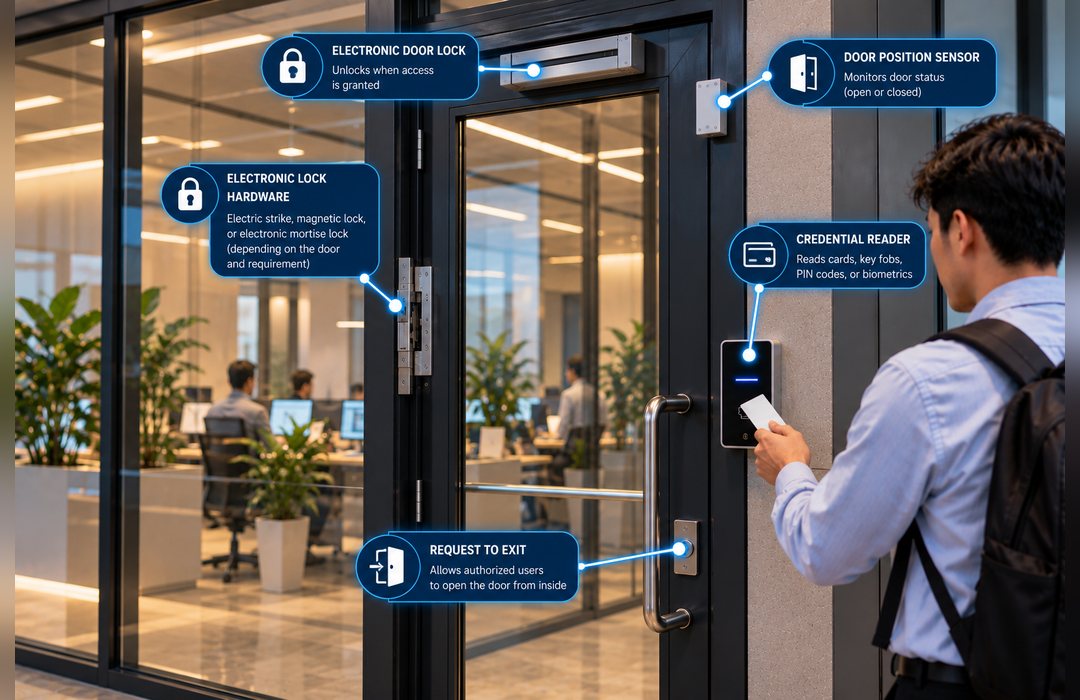
Depending on the door and security requirements, a system may include electric strikes, magnetic locks, electronic mortise locks, readers, door controllers, request-to-exit devices, door position sensors, and power supplies.
Foxcon Total Solutions, Inc. provides access control and integrated security services that can support electronic door locking environments.
Why Choose Electronic Door Lock Systems?
Traditional mechanical keys can become difficult to manage when many employees, departments, tenants, or contractors require access to different areas. If a key is lost or duplicated, the organization may need to replace cylinders, rekey doors, or redistribute new keys depending on the situation.
Electronic Door Lock Systems Philippines provide a more manageable way to control access privileges. Compatible access control systems can add, change, or remove user permissions without physically replacing the locking hardware each time an employee changes roles or leaves the organization.
Electronic locking also supports more detailed access policies. Different users can be permitted to enter specific doors during approved schedules, while other areas remain restricted. Access events may also be logged when the lock is integrated with a compatible controller and management platform.
These systems can complement Access Control Systems, Biometric Access Control Solutions, Door Access Controller Systems, Visitor Management Systems, CCTV Surveillance Systems, and Building Security Integration.
How Electronic Door Lock Systems Work
An electronic door locking environment normally combines a locking device with a reader, controller, power source, and supporting access control infrastructure. When a user presents a credential, the reader sends the credential information to the access controller for verification.
If the credential and access permissions are valid, the controller sends the appropriate signal to release or unlock the door. The exact process depends on the type of locking hardware and the way the access control system has been designed.
Electric strikes typically release the door latch while leaving the strike mounted in the frame. Magnetic locks use electromagnetic force to hold the door closed, while electronic mortise or other electromechanical locks integrate the locking mechanism into the door hardware itself.
Door position sensors can report whether the door is open or closed, while request-to-exit devices support controlled egress. These components can also help the access control system detect conditions such as a door being forced open or held open longer than expected, depending on the system configuration.
Electronic Door Lock Systems Safety & Trust
Electronic door locks should be selected according to the door type, locking hardware, access requirements, occupancy conditions, and applicable life-safety requirements. A secure door should still allow the required emergency egress for people inside the facility.
The behavior of the lock during a power failure is especially important. Some locking arrangements are designed to unlock when power is removed, while others remain mechanically locked depending on the hardware and application. The appropriate behavior should be determined by the complete door and life-safety design rather than by security preference alone.
Backup power may be provided for controllers, readers, and selected locking devices where continued operation is required. However, battery or UPS support should not be used to override required emergency release functions.
Foxcon Total Solutions, Inc. supports security projects through Engineering and Design, Supply and Installation, Project Implementation, System Integration, Testing and Commissioning, Preventive Maintenance, and related technical services.
Electronic Door Lock Systems Tips
-
Match the lock to the door. Door construction, frame type, hardware, and traffic level affect lock selection.
-
Define access privileges first. Decide who should access each area and during what schedules.
-
Coordinate the complete door hardware. Readers, locks, controllers, sensors, and exit devices should work together.
-
Verify emergency egress. Security controls should not prevent required evacuation.
-
Check power requirements. Confirm the controller and power supply can support the connected locking hardware.
-
Consider backup power where appropriate. Critical access control components may require continuity during selected outages.
-
Test door position sensors. Confirm open, closed, forced-open, and held-open conditions where supported.
-
Review user permissions regularly. Remove access that is no longer required.
-
Document each controlled door. Record lock type, controller, reader, power supply, and system configuration.
Test the Complete Door Sequence, Not Just the Reader
A reader accepting an access card does not prove that the entire controlled door is working correctly. The credential may be recognized while the lock fails to release, the door sensor reports the wrong status, or the request-to-exit device does not operate as intended.
Commissioning should therefore test the complete sequence from credential presentation to physical door operation. This includes checking authorization, controller output, lock release, door opening, door position detection, relocking, and any configured alarm conditions.
Emergency and power-loss behavior should also be verified according to the approved design. Technical teams should understand what happens when the controller loses communication, the power supply fails, the fire or emergency interface activates, or the backup power is exhausted.
Testing the entire sequence helps identify installation and integration problems that cannot be found by checking the reader or electronic lock individually.
Frequently Asked Questions
What is an Electronic Door Lock System?
An Electronic Door Lock System uses electrically controlled locking hardware together with compatible access control equipment to manage entry through a door.
What types of electronic door locks are available?
Depending on the application, systems may use electric strikes, magnetic locks, electronic mortise locks, electromechanical locks, or other compatible locking hardware.
Can electronic locks work with biometric access?
Yes. Compatible biometric readers can be connected to access control systems that operate suitable electronic locking hardware.
What is the difference between an electronic lock and a smart lock?
The terms can overlap, but a smart lock usually emphasizes connected or app-based features, while electronic locks more broadly include electrically operated locking hardware used in residential, commercial, hospitality, or enterprise access control systems.
What happens if power is lost?
The result depends on the lock type, power supply, backup power, system design, and life-safety requirements. Some locks release when power is removed, while other hardware may remain mechanically secured.
Can electronic door locks integrate with CCTV?
Yes. Compatible access control and CCTV platforms can associate door events with corresponding surveillance footage.
Can electronic locks record who entered a door?
When integrated with a compatible access control platform, the system may log credential events, access decisions, door status, and timestamps.
Are Electronic Door Lock Systems suitable for commercial buildings?
Yes. They are widely used in offices, hotels, hospitals, schools, warehouses, data centers, and other facilities requiring controlled access.
Check the Locking Method Before Choosing the Credential
It is easy to focus on whether users will enter with a card, PIN, fingerprint, or mobile credential, but the locking hardware and door construction are just as important. A sophisticated credential system cannot compensate for unsuitable or poorly installed door hardware.
Before selecting readers and credentials, the project should review whether the door requires an electric strike, magnetic lock, electronic mortise lock, or another solution. Door swing, frame construction, existing mechanical hardware, fire-rating requirements, exit hardware, traffic level, and required security level can all affect the choice.
The locking method should also be coordinated with how people exit the space and how the door behaves during emergencies or power interruptions. These requirements can determine the appropriate hardware before the access credential is selected.
Designing from the physical door outward helps ensure that the access control system is both secure and practical to operate.
Design the Door Around Security and Safe Egress
A properly planned Electronic Door Lock Systems Philippines environment should consider door construction, locking method, credentials, controllers, power supplies, sensors, emergency release, access permissions, and integration with surrounding security systems.
Foxcon Total Solutions, Inc. can support electronic door lock planning, access control deployment, security integration, installation, testing, commissioning, documentation, and preventive maintenance for commercial and institutional facilities.
📞 Contact us today to discuss your electronic door locking and access control requirements.
📍 Serving businesses in Cebu, Metro Manila, and nationwide.
🌐 Explore Foxcon’s solutions to learn more about our services.
References
1. Entry Point – Smart Locks vs. Electronic Locks
https://entry-point-wa.myshopify.com/blogs/insights/smart-locks-vs-electronic-locks-what-s-the-difference
2. dormakaba – Electronic Door Locks
https://www.dormakaba.com/us-en/offering/products/electronic-access-data/electronic-door-locks
3. Vivint – Electronic Door Lock Features
https://www.vivint.com/resources/article/electronic-door-features
4. Omnitec Systems – Types of Electronic Door Lock Systems
https://www.omnitecsystems.com/omni/blog/types-of-electronic-door-lock-systems
5. SALTO Systems – Electronic Locks
https://saltosystems.com/en/products/electronic-locks/