


News and Events
Building Security Integration Philippines: Connecting Surveillance, Access Control, and Alarm Systems
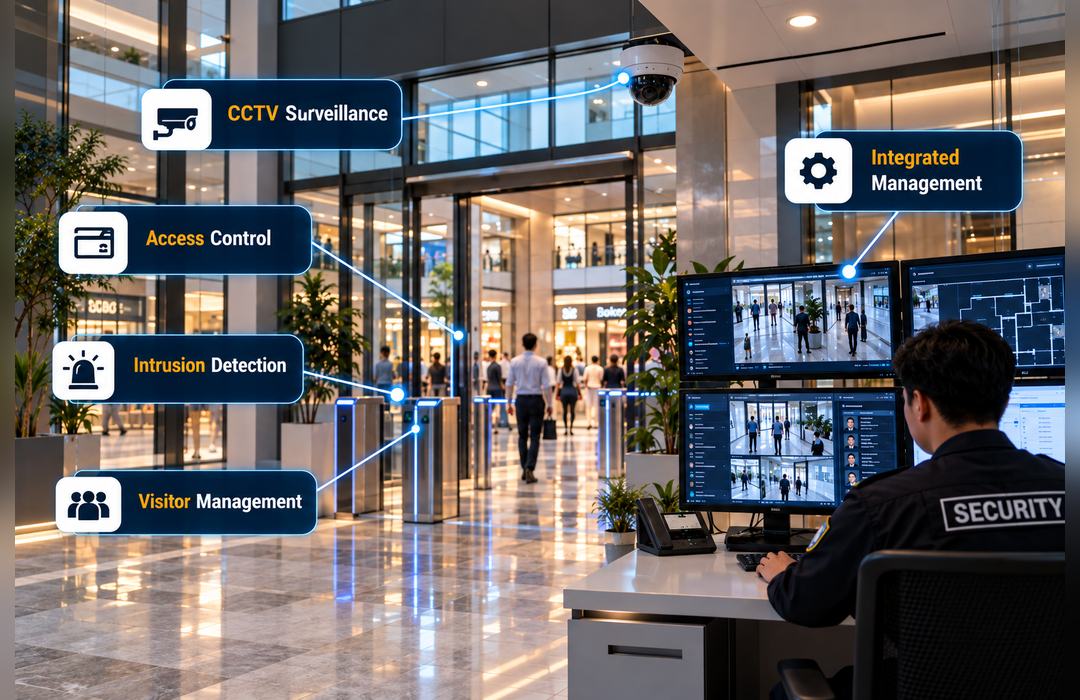
What Is Building Security Integration?
Building Security Integration Philippines refers to the coordinated connection of compatible security technologies so they can exchange information, trigger defined responses, and support more centralized security operations.
Instead of treating CCTV, access control, intrusion detection, visitor management, and other security platforms as completely separate systems, integration allows selected events and data to move between them according to the facility’s operational requirements.
This approach is commonly used in offices, hospitals, schools, hotels, manufacturing facilities, government buildings, commercial complexes, and other environments where several security systems must work together.
Foxcon Total Solutions, Inc. provides integrated security and auxiliary system solutions that can help organizations connect compatible technologies into a more organized security environment.
Why Choose Building Security Integration?
Modern facilities often depend on multiple security systems at the same time. A security team may monitor CCTV on one platform, access control on another, visitor records on a separate system, and intrusion alarms through another interface.
When these systems remain isolated, personnel may need to compare information manually during an incident. Building Security Integration can reduce that gap by connecting defined workflows between compatible platforms.
For example, a forced-door event from an access control system may be associated with a nearby camera so security personnel can immediately review the relevant video. An intrusion alarm may also trigger a visual alert, bring a specific camera to an operator’s screen, or initiate a recording response, depending on the system design.
The objective is not simply to put every security technology on one platform. Effective integration should improve visibility, reduce unnecessary manual steps, and help personnel understand what is happening during a security event.
How Building Security Integration Works
The process begins by identifying which systems need to exchange information and what actions should occur when a specific event is detected. Technical teams then review compatibility between hardware, software, network infrastructure, communication protocols, APIs, licensing, and manufacturer-supported interfaces.
Depending on the platforms involved, integration may use:
-
APIs or software connectors
-
Network-based communication
-
Manufacturer integration modules
-
Relay or input/output connections
-
Centralized security management software
-
Video Management Systems
-
Access control integration interfaces
-
Alarm monitoring platforms
A typical workflow may begin with an event such as an invalid access attempt. The access control platform records the event, then sends information to a compatible integrated system. The security interface may display the associated camera, generate an alert, or provide related access details to authorized personnel.
Another workflow could involve an intrusion sensor that triggers an alarm and calls up the relevant CCTV view for verification. After configuration, the entire workflow should be tested to confirm that alarms, video, access events, notifications, and operator actions behave as intended.
Building Security Integration Safety & Trust
Security integration can improve coordination, but it also creates dependencies between systems. If several security technologies rely on the same network switch, server, controller, or software platform, failure of that shared component may affect more than one security function.
This is why system architecture should be reviewed for important single points of failure.
Cybersecurity is also important because many modern security platforms operate over IP networks. Administrative access should be restricted, default credentials should be changed where applicable, software and firmware should be maintained, and remote access should be controlled according to the organization’s security requirements. Network segmentation may also be used to separate security devices from unrelated corporate or guest traffic where appropriate.
Compatibility should be confirmed before implementation. Not every camera, controller, alarm panel, visitor platform, or software application can communicate directly with every other system.
Foxcon Total Solutions, Inc. supports security and building technology projects through Engineering and Design, Supply and Installation, Project Implementation, Testing and Commissioning, Preventive Maintenance, and related technical services.
Building Security Integration Tips
-
Define the security workflow first. Decide what should happen when a specific event occurs.
-
Confirm compatibility early. Check hardware, software, APIs, protocols, and licensing requirements.
-
Associate events with useful information. Link alarms to the relevant camera, door, area, or user record where supported.
-
Limit administrative privileges. Give users only the access required for their roles.
-
Use reliable network infrastructure. Integrated security depends on stable connectivity.
-
Segment security systems where appropriate. Avoid unnecessary exposure to unrelated network traffic.
-
Identify shared points of failure. Review servers, switches, controllers, and communication links.
-
Test complete event sequences. Do not test only individual devices.
-
Keep system time synchronized. Accurate timestamps help correlate video, access records, and alarms.
-
Update documentation after changes. Integration maps and configuration records should reflect the current environment.
Synchronize Events So Security Teams See the Same Incident Across Systems
One of the most useful aspects of security integration is the ability to connect information from different technologies around the same event. Consider an employee attempting to enter a restricted area with an invalid credential.
In an isolated environment, the access control system may simply record the denied entry. A security operator may then need to manually identify the nearby CCTV camera and search for the correct time in the video system. With a properly configured integration, the access event can be associated with the relevant camera. The operator may receive the access record and camera view together, making it easier to understand what happened.
Accurate time synchronization becomes important in this type of environment. If the access control server and CCTV system have different timestamps, an operator may have difficulty matching the event with the correct video.
Integration therefore involves more than connecting software. Network reliability, system clocks, event configuration, user permissions, and operational procedures all contribute to whether the workflow is useful during a real incident.
Frequently Asked Questions
What is Building Security Integration?
Building Security Integration is the process of connecting compatible security technologies so they can exchange selected information and support coordinated monitoring and response.
What systems can be integrated?
Depending on compatibility, integration may involve CCTV, Access Control Systems, Intrusion Alarm Systems, Visitor Management Systems, Intelligent Video Analytics, intercom systems, alarm monitoring, and centralized security platforms.
Can CCTV and Access Control Systems work together?
Yes. Compatible platforms can associate access events with nearby camera footage or automatically display relevant video when a defined event occurs.
Can intrusion alarms be connected to CCTV?
Yes, depending on system compatibility. An intrusion alarm may trigger a camera display, recording action, or notification within the integrated security environment.
Why is compatibility important?
Different systems may use proprietary software, protocols, APIs, interfaces, and licensing requirements. These should be reviewed before integration begins.
Does integration mean one platform controls every security system?
Not necessarily. Some integrations provide event sharing or centralized monitoring only, while others support selected commands or automation.
Why should integrated security systems be tested before turnover?
Testing confirms that alarms, video responses, access records, notifications, and other workflows operate correctly together instead of simply verifying that each individual device works.
Design Security Integration Around the Incident Response Workflow
Create a more coordinated security environment with professionally planned Building Security Integration Philippines. From compatibility assessment and network planning to CCTV, access control, alarm integration, workflow configuration, testing, commissioning, and documentation, Foxcon Total Solutions, Inc. can help organizations connect security technologies around real operational requirements.
📞 Contact us today to discuss your integrated security requirements.
📍 Serving businesses in Cebu, Metro Manila, and nationwide.
🌐 Explore Foxcon’s solutions to learn more about our services.
References
1. G6S Security – Integrating Building Security With Other Building Systems
https://g6s-security.co.uk/integrating-building-security-with-other-building-systems/
2. Building Security – Systems Integration
https://www.buildingsecurity.com/systems-integration/
3. Larnitech – Integrated Building Security Systems Explained
https://www.larnitech.com/blog/integrated-building-security-systems-explained/
4. Silver Star Protection – Security System Integration for Commercial Buildings
https://www.silverstarprotection.com/glossary/security-system-integration-for-commercial-buildings/
5. EK Tech – The Importance of Security Systems Integration in Buildings
https://ektech.com.my/the-importance-of-security-systems-integration-in-buildings/