


News and Events
Emergency Communication Systems Philippines: Delivering Clear Instructions When Every Second Matters
What Are Emergency Communication Systems?
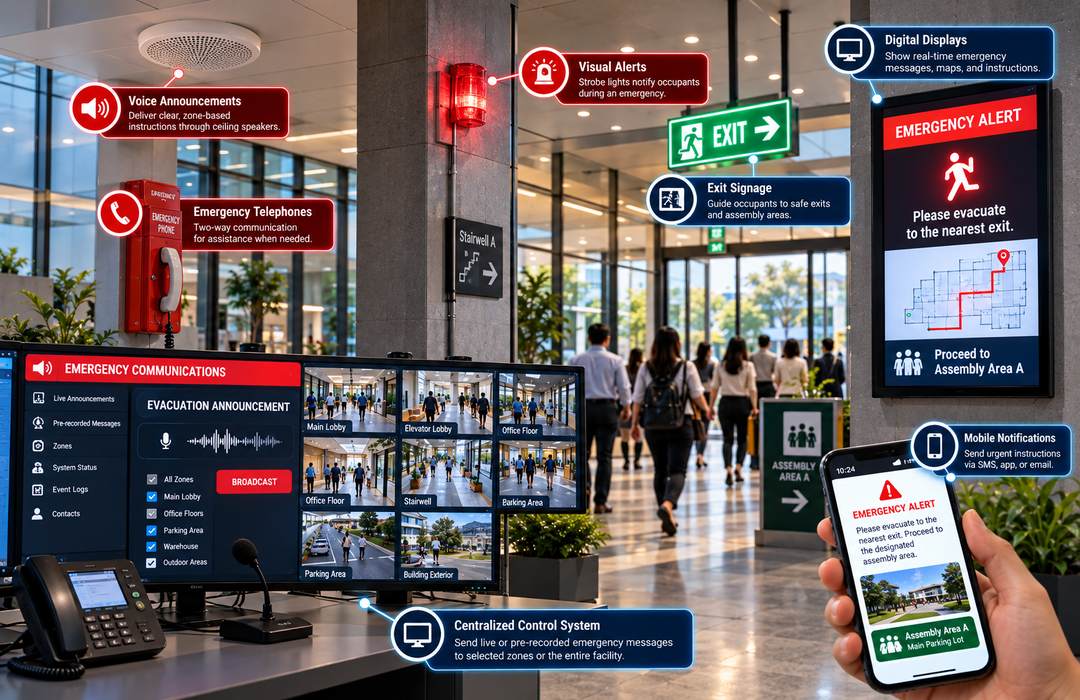
Emergency Communication Systems Philippines help organizations send urgent instructions to employees, visitors, contractors, and other people inside or connected to a facility during a critical event. Their purpose is simple: get the right information to the right people quickly enough for them to act.
An emergency message may be delivered through speakers, visual alerts, emergency telephones, text messages, email, mobile notifications, or other communication channels. Using more than one method is particularly useful in large or busy facilities, where a single alarm or announcement may not reach everyone.
Communication can also work in both directions. Some systems only send instructions, while others allow occupants or designated personnel to respond, confirm their status, or request assistance. This can give emergency teams more information as conditions change.
Foxcon Total Solutions, Inc. provides Emergency Communication Systems for offices, hospitals, schools, hotels, manufacturing facilities, warehouses, commercial properties, and other environments where clear emergency instructions are essential.
Why Choose Emergency Communication Systems?
An alarm can tell people that something is wrong, but it may not tell them what has happened, where the problem is, or what they should do next. That distinction matters during an emergency. Occupants may need to evacuate through a particular route, avoid part of the building, move to another assembly area, remain where they are, or wait for further instructions.
An Emergency Communication System gives authorized personnel a way to provide that additional information instead of relying on occupants to interpret a warning on their own.
Using several communication methods can also help reach people who may miss a traditional alarm. Loud machinery, isolated rooms, accessibility requirements, or simply being away from the facility can affect whether someone receives a warning.
For facilities with visitors and contractors, clear instructions are especially important. Unlike employees, these individuals may not know the building layout, emergency exits, or designated assembly areas.
How Emergency Communication Systems Work
An emergency message starts with an event or an authorized decision to issue an alert. Depending on the setup, this may follow a fire alarm, security incident, severe weather warning, equipment emergency, or another situation covered by the facility’s emergency plan.
The system then sends the appropriate message through the available communication channels. Inside the property, speakers and visual devices may provide instructions. Other platforms may send notifications to phones, computers, or designated personnel.
Messages can also be directed to specific groups or areas when the system supports targeted communication. For example, occupants near an affected area may receive different instructions from people elsewhere in the property.
Some systems allow two-way communication as well. Employees may be able to confirm that they are safe, while someone who needs assistance can report their situation to designated personnel.
The important point is that emergency communication should not stop after the first warning. Conditions can change, so organizations need a way to issue updated instructions when an evacuation route, assembly point, or response procedure changes.
Emergency Communication Systems Safety & Trust
Emergency messages should be short, specific, and easy to understand. During a stressful situation, complicated instructions or technical language can create additional confusion.
The system also needs more than one way to reach people when appropriate. Speakers may work well for occupants inside a building, while mobile notifications can reach employees who are elsewhere or cannot clearly hear an announcement.
Backup power should be considered for essential equipment because an emergency may happen at the same time as an electrical interruption. The communication system should also be included in the facility’s testing and maintenance schedule rather than being checked only after a fault appears.
Access to emergency controls must be restricted to authorized personnel. Sending the wrong alert, selecting the wrong area, or broadcasting an unclear message can interfere with the response.
Emergency communication requirements can also vary according to the building, occupancy, system purpose, and applicable regulations. System design should therefore be coordinated with the facility’s emergency procedures and relevant life-safety requirements.
Emergency Communication Systems Tips
-
Write emergency messages in plain language that occupants can understand immediately.
-
Decide in advance who is authorized to issue or update emergency notifications.
-
Use more than one communication channel when a single method may not reach everyone.
-
Include employees, visitors, contractors, and people working in isolated areas when planning coverage.
-
Create different messages for situations that require evacuation, sheltering, restricted movement, or other actions.
-
Check whether important announcements can be heard and understood in noisy areas.
-
Make sure emergency contact information stays current.
-
Test speakers, visual alerts, emergency phones, control equipment, network connections, and backup power regularly.
-
Use drills to find communication gaps instead of assuming the system will work as expected during a real incident.
Keep Instructions Useful as the Situation Changes
The first emergency message is not always the last one people need. Consider a facility where employees are initially told to evacuate to their normal assembly area. If smoke, flooding, a security incident, or another hazard makes that location unsafe, occupants need updated instructions quickly.
A system that can send targeted follow-up messages gives emergency personnel a practical way to redirect people instead of relying on word of mouth.
Two-way communication can add another layer of information. Personnel may be able to confirm who has reached an assembly area, while occupants can report that they are safe, outside the property, or in need of assistance.
This is why emergency communication planning should consider the entire event rather than focusing only on the initial alarm. Organizations need a way to warn people, explain what they should do, update those instructions when conditions change, and communicate with the people responsible for managing the response.
Frequently Asked Questions
What is an Emergency Communication System?
An Emergency Communication System is an integrated solution that delivers voice announcements, alerts, and emergency instructions to building occupants during critical situations such as fires, security incidents, or other emergencies.
What technologies are included in an Emergency Communication System?
An Emergency Communication System may include Public Address Systems, Fire Alarm Systems, emergency telephones, speakers, microphones, visual notification devices, mass notification platforms, and centralized communication software.
Where are Emergency Communication Systems commonly used?
Emergency Communication Systems are commonly installed in office buildings, hospitals, schools, hotels, manufacturing facilities, warehouses, government buildings, transportation hubs, and other commercial properties where occupant safety is a priority.
Can Emergency Communication Systems integrate with other building technologies?
Yes. Modern Emergency Communication Systems can integrate with Fire Alarm Systems, Public Address Systems, Building Management Systems (BMS), CCTV, Access Control Systems, and other life safety technologies to improve coordination during emergencies.
Why is emergency communication important for commercial facilities?
Clear and timely communication helps occupants understand emergency instructions, supports organized evacuations, improves coordination with emergency responders, and reduces confusion during critical situations.
Why is preventive maintenance important for Emergency Communication Systems?
Routine inspections, testing, software updates, and preventive maintenance help ensure communication equipment, speakers, microphones, emergency telephones, and backup power systems continue operating reliably when emergency communication is needed most.
Prepare Your Facility for Faster Emergency Communication
Help occupants and facility teams communicate more effectively during critical situations with dependable Emergency Communication Systems. From system design and equipment installation to integration, testing, and maintenance, Foxcon Total Solutions, Inc. can support your emergency communication requirements.
📞 Contact us today to discuss your emergency communication needs.
📍 Serving businesses in Cebu, Metro Manila, and nationwide.
🌐 Explore Foxcon’s solutions to learn more about our services.
References
-
Cybersecurity and Infrastructure Security Agency (CISA) – Emergency Communications
https://www.cisa.gov/topics/emergency-communications -
FacilityOS – The Importance of Digital Emergency Communication Systems
https://www.facilityos.com/blog/emergency-communication-systems -
911Cellular – Stay Connected: The Importance of Emergency Communication Systems
https://911cellular.com/blog/stay-connected-the-importance-of-emergency-communication-systems -
ARES Security – Exploring Different Types of Emergency Communication Systems
https://aressecuritycorp.com/2024/08/20/emergency-communication-systems/ -
UAV Latam – Emergency Communication System: What Does It Consist of and How Does It Work?
https://uavlatam.com/en/sistema-de-comunicacion-de-emergencia/