


News and Events
Voice Evacuation Systems Philippines: Supporting Clear Communication During Building Emergencies
What Are Voice Evacuation Systems?
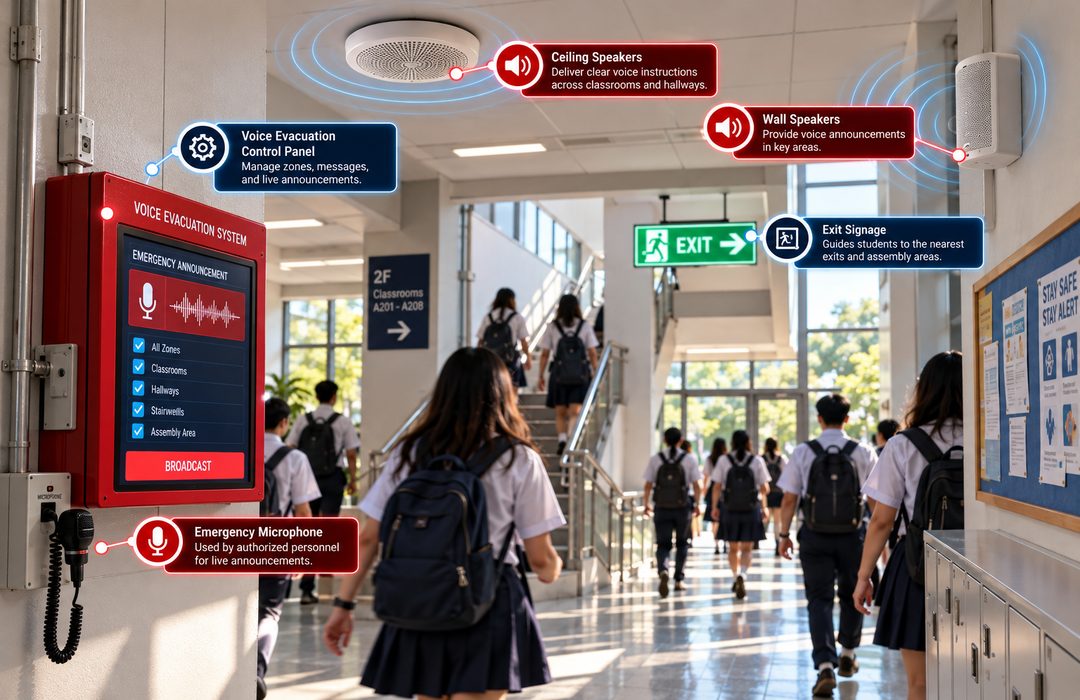
Voice Evacuation Systems Philippines are emergency communication solutions designed to deliver recorded or live spoken instructions to building occupants during fire incidents and other emergencies.
Unlike systems that rely only on sirens, bells, or warning tones, voice evacuation systems can provide specific instructions about what occupants should do, where they should go, or whether they should remain in place while emergency procedures are carried out.
These systems are commonly used in commercial buildings, hospitals, hotels, schools, shopping centers, transportation facilities, industrial sites, government buildings, and other large or complex environments where clear emergency communication is important.
Voice evacuation may work alongside Fire Detection and Alarm Systems, Public Address Systems, Emergency Communication Systems, amplifiers, speakers, control panels, microphones, and other fire-life safety technologies. Foxcon Total Solutions, Inc. provides integrated building technology solutions that can support professionally planned emergency communication environments.
Why Choose Voice Evacuation Systems?
During an emergency, an alarm tone can warn occupants that something is wrong, but it may not always explain what action they should take. Voice Evacuation Systems add spoken information to the warning process.
Depending on the system design, messages can instruct occupants to evacuate, move toward designated exits, remain in a safe area, or follow other approved emergency procedures.
This can be particularly useful in large buildings where different floors, departments, or zones may require different instructions. For example, an incident affecting one section of a facility may not require every area to receive the same message at the same time.
Zoned voice evacuation can support a more controlled response where the approved emergency strategy requires different instructions for different areas. Voice systems can also provide live announcements so authorized personnel can communicate updated instructions when predefined recorded messages are not sufficient.
How Voice Evacuation Systems Work
A Voice Evacuation System typically includes control equipment, amplifiers, loudspeakers, communication circuits, microphones, message storage or processing equipment, and supporting power infrastructure. The system may be integrated with compatible fire detection or emergency control equipment.
When an alarm condition is activated, the voice evacuation system can play predefined messages through speakers assigned to specific zones. Depending on the system and approved emergency sequence, messages may include instructions to:
-
Evacuate the building
-
Leave a specific floor or area
-
Proceed toward designated exits
-
Remain in place temporarily
-
Avoid particular areas
-
Follow instructions from emergency personnel
Authorized personnel may also use an emergency microphone to make live announcements. Amplifiers distribute the audio signal to speaker circuits throughout the protected areas. Larger facilities may use multiple amplifiers or distributed equipment to support different zones and coverage requirements.
Backup or standby power is also an important part of system planning because emergency communication may still be required when normal electrical power is unavailable.
Voice Evacuation Systems Safety & Trust
Emergency voice communication must be understandable when occupants need it most. Simply installing speakers throughout a building does not guarantee that messages will be clear.
Speaker placement, sound-pressure levels, background noise, room acoustics, ceiling height, partitions, occupancy conditions, and equipment settings can all affect speech intelligibility. The system should therefore be designed around the actual building environment rather than relying only on the number of speakers installed.
Integration with fire and life-safety systems also requires careful planning. The required alarm sequence, zoning, message priorities, manual controls, monitoring functions, and interfaces should follow the approved system design, applicable requirements, and equipment manufacturer guidance.
Critical equipment should also be protected against single failures where required by the project design. Routine inspection and testing remain important after turnover. Speakers, amplifiers, microphones, control equipment, communication circuits, and standby power should be checked according to the applicable maintenance requirements.
Foxcon Total Solutions, Inc. supports projects through Engineering and Design, Supply and Installation, Project Implementation, Testing and Commissioning, Preventive Maintenance, and related technical services.
Voice Evacuation Systems Tips
-
Assess the building before locating speakers. Room size, ceiling height, background noise, and layout affect coverage.
-
Plan communication zones carefully. Large facilities may require different instructions for different areas.
-
Keep emergency messages simple. Instructions should be concise and easy to understand.
-
Coordinate with fire detection systems. Alarm conditions and voice sequences should follow the approved emergency strategy.
-
Provide suitable standby power. Critical communication equipment may need to remain available during power interruptions.
-
Check speech intelligibility. Loud audio is not automatically understandable audio.
-
Protect emergency microphone access. Only authorized personnel should be able to issue emergency announcements.
-
Verify message priorities. Emergency messages should take priority over normal background music or routine announcements where required.
-
Test complete alarm sequences. Confirm detection, activation, messaging, zoning, and speaker output together.
-
Include the system in preventive maintenance. Regular inspection helps identify faults before an emergency occurs.
Design for Speech Intelligibility, Not Just Speaker Volume
One of the most important considerations in a Voice Evacuation System is whether occupants can actually understand the message. Increasing speaker volume does not always solve the problem.
Imagine a large commercial lobby with hard floors, glass walls, and a high ceiling. The space may create significant sound reflections. A message can be loud enough to hear but still difficult to understand because words overlap as sound reflects around the room.
Factories, transportation facilities, parking areas, and other noisy environments create a different challenge. Background noise can interfere with speech even when speakers are operating correctly. System design should therefore consider both coverage and intelligibility.
Speaker type, mounting location, spacing, amplifier settings, zoning, ambient noise, acoustics, and message quality may all influence the final result. Testing should confirm not only that sound is present throughout the designated area but also that emergency instructions can be understood.
Frequently Asked Questions
What is a Voice Evacuation System?
A Voice Evacuation System is an emergency communication solution that uses recorded or live spoken messages to provide instructions to building occupants during fire incidents or other emergencies.
How is voice evacuation different from a standard fire alarm?
A conventional alarm may primarily use tones, bells, or sirens to indicate an emergency. Voice evacuation adds spoken instructions that can tell occupants what action to take.
Can Voice Evacuation Systems integrate with Fire Detection and Alarm Systems?
Yes. Depending on compatibility and approved system design, voice evacuation can be activated by fire alarm conditions and coordinated with defined evacuation sequences.
What is zoned voice evacuation?
Zoning allows different areas of a building to receive different messages or instructions when required by the emergency strategy.
Can authorized personnel make live emergency announcements?
Many systems support emergency microphones that allow authorized personnel to issue live instructions in addition to prerecorded messages.
Why is speech intelligibility important?
Occupants must be able to understand emergency instructions. Speaker volume alone does not guarantee clear speech, especially in noisy or acoustically difficult spaces.
Why should Voice Evacuation Systems be tested regularly?
Routine testing helps verify that speakers, amplifiers, microphones, control equipment, communication circuits, standby power, and programmed messages remain operational.
Make Sure Occupants Can Understand the Message, Not Just Hear the Alarm
Support clearer emergency communication with professionally planned Voice Evacuation Systems Philippines. From system engineering and speaker-layout planning to equipment installation, fire-system integration, zoning, testing, commissioning, and preventive maintenance, Foxcon Total Solutions, Inc. can help organizations develop emergency communication systems around the actual requirements of their facilities.
📞 Contact us today to discuss your voice evacuation requirements.
📍 Serving businesses in Cebu, Metro Manila, and nationwide.
🌐 Explore Foxcon’s solutions to learn more about our services.
References
-
Sovereign Fire & Security – What Are Voice Evacuation Systems?
https://www.sovereignfireandsecurity.co.uk/news/what-are-voice-evacuation-systems/ -
SigCom – Reasons to Add Voice Evacuation to an Existing Fire Alarm System
https://sigcom.com/5-reasons-to-add-voice-evacuation-to-an-existing-fire-alarm-system/ -
EPS Security – Voice Evacuation vs. Traditional Fire Alarm Systems
https://www.epssecurity.com/news/business-security/voice-evacuation-vs-traditional-fire-alarm-systems-the-next-generation-of-business-protection/ -
Ambient System – What Is a Voice Alarm System?
https://ambientsystem.eu/en/what-is-a-voice-alarm-system/ -
DigiMRO – Voice Evacuation System Glossary
https://www.digimro.com/glossary/voice-evacuation-system