

News and Events
Complete Guide to Access Control Systems: Smarter Security for Commercial Facilities
What Are Access Control Systems?
Access Control Systems manage who can enter a building, room, or restricted area. Instead of relying only on physical keys, these systems verify a person using an approved credential such as an access card, PIN, fingerprint, facial scan, or mobile device.
The basic process is simple: the system verifies the credential and checks whether the person is allowed to enter. Access can be granted based on the user’s role, location, schedule, or other rules set by the organization. This allows employees to access only the areas they need for their work.
For commercial facilities, access control also creates a record of entry activity. Security or facility teams can review when a credential was used, which entry point was accessed, and whether access was granted or denied.
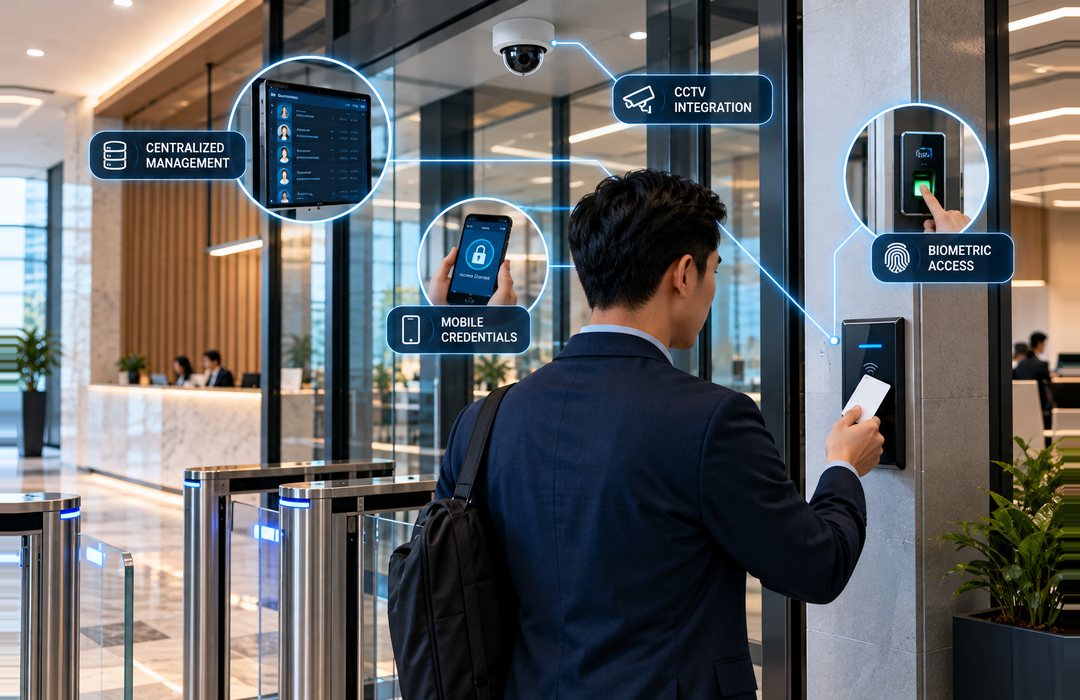
Modern systems can support cards, biometrics, mobile credentials, readers, and centralized controllers. Depending on the setup, they can also work with CCTV, intrusion alarms, visitor management, and other security technologies.
Foxcon Total Solutions, Inc. provides Access Control Systems for offices, warehouses, hospitals, schools, industrial facilities, government buildings, and other commercial environments.
Why Choose Access Control Systems?
Traditional keys have one major limitation: once a key is issued, controlling what happens to it becomes difficult. If it is lost, copied, or not returned, an organization may need to replace locks or issue new keys.
With an Access Control System, administrators can deactivate a lost credential without changing the physical lock. Permissions can also be updated when an employee changes roles, moves to another location, or leaves the company.
Access should be based on a person’s responsibilities rather than simply being granted because someone works in the building. Regular reviews can identify credentials that are no longer needed or users who have more access than their current role requires.
Access records also give security teams useful information when investigating an incident. When access control is connected with CCTV, personnel can compare a door event with recorded video instead of relying only on timestamps or reviewing footage without a specific reference point.
How Access Control Systems Work
The process starts when a person presents a credential to a reader. Depending on the system, this could be a card, PIN, fingerprint, facial scan, or authorized mobile device.
The system checks the credential and determines whether the person has permission to use the requested entry point. This decision can consider the specific door, the user’s assigned access level, and the time the request is made.
If access is approved, the connected electronic lock, gate, or turnstile releases. If the request does not meet the configured permissions, entry remains locked, and the event can be recorded.
Administrators can manage credentials, change permissions, review access activity, and disable user access through the management platform. Depending on the system, alerts may also be generated for repeated denied attempts or other events that require attention.
Access Control Systems Safety & Trust
An Access Control System should protect restricted areas without making everyday movement unnecessarily difficult. Proper planning starts with identifying which doors need controlled access, who needs access, what credentials should be used, and what should happen during an emergency.
Life-safety requirements must be considered when electronic locks are installed. Secured doors should not prevent occupants from following the facility’s required emergency exit procedures.
The security of credentials and the management platform also matters. Administrative access should be limited to authorized personnel, and user permissions should be reviewed regularly rather than remaining unchanged for long periods.
Organizations should also consider future requirements. Modern access control can include smart cards, mobile credentials, biometric readers, and other options, so selecting equipment that can support future users, doors, and credential types can reduce the need for early replacement.
Backup power, readers, electronic locks, controllers, and communication connections should also be included in regular testing and preventive maintenance.
Foxcon Total Solutions, Inc. can help organizations plan, install, integrate, test, and maintain Access Control Systems based on actual facility and security requirements.
Access Control Systems Tips
-
Map the areas that actually need controlled entry instead of placing readers on doors without a clear security purpose.
-
Give employees access based on their current responsibilities and remove permissions they no longer need.
-
Disable lost cards, mobile credentials, and former employee access as soon as possible.
-
Review access permissions regularly to identify inactive credentials or users with unnecessary access.
-
Consider stronger verification for sensitive areas, such as combining a credential with biometric identification.
-
Connect access events with CCTV where incident verification is important.
-
Include readers, electronic locks, controllers, backup batteries, and network connections in preventive maintenance.
-
Plan for future users, doors, and credential types before selecting the system.
Make Access Decisions Easier to Manage
The right Access Control System is not simply the one with the most features. It should match how people actually move through and use the facility.
An office may need different permissions for employees, visitors, IT rooms, and executive areas. A warehouse may need tighter control around inventory, loading areas, and equipment rooms. Hospitals, schools, factories, and data centers also have different entry patterns and security priorities.
A professional assessment can identify which locations need controlled access, how many users the system must support, which credentials are practical, and whether CCTV, visitor management, or other security systems should be connected.
This gives the organization a system based on its actual operations rather than applying the same security setup to every door and user.
Frequently Asked Questions
What is an Access Control System?
An Access Control System manages who can enter specific buildings, rooms, or restricted areas. It verifies users through credentials such as cards, PIN codes, biometric scans, or mobile devices before granting or denying access.
How does an Access Control System improve building security?
It limits entry to authorized individuals, records access activity, and allows administrators to manage permissions from a centralized platform. This helps reduce unauthorized access and provides useful information when investigating security incidents.
What is the difference between card access and biometric access?
Card access uses a physical or mobile credential presented to a reader. Biometric access verifies a person using a physical characteristic, such as a fingerprint or facial scan. Unlike a card that can be lost or shared, biometric verification is linked to the individual.
Can Access Control Systems integrate with CCTV?
Yes. Access Control Systems can be integrated with CCTV so security teams can connect access events with recorded video. This makes it easier to review denied entry attempts and investigate security incidents.
Where are Access Control Systems commonly used?
They are commonly installed in offices, warehouses, hospitals, schools, hotels, manufacturing facilities, data centers, government buildings, and other properties that require controlled entry.
Why is preventive maintenance important?
Preventive maintenance helps keep readers, locks, controllers, software, communication connections, and backup power systems working properly. Regular testing can also identify faults before they affect security or daily operations.
Strengthen Access Security Across Your Facility Now!
Improve how your organization manages entry to restricted areas with a professionally planned Access Control System. Whether you need card access, biometric authentication, electronic door locking, system integration, testing, or maintenance, Foxcon Total Solutions, Inc. can help develop a solution suited to your security requirements.
📞 Contact us today to discuss your access control needs.
📍 Serving businesses in Cebu, Metro Manila, and nationwide.
🌐 Explore Foxcon’s solutions to learn more about our services.
References
-
ScienceDirect – Access Control System
https://www.sciencedirect.com/topics/computer-science/access-control-system -
Fortinet – What Is Access Control?
https://www.fortinet.com/resources/cyberglossary/access-control -
Nedap Security – What Is Access Control?
https://www.nedapsecurity.com/insight/what-is-access-control/ -
HID Global – Access Control Systems
https://www.hidglobal.com/solutions/access-control-systems -
SailPoint – Different Types of Access Control Systems
https://www.sailpoint.com/identity-library/what-are-the-different-types-of-access-control-systems