


News and Events
Commercial Ventilation Control Systems Philippines: Managing Airflow Across Building Environments
What Are Commercial Ventilation Control Systems?
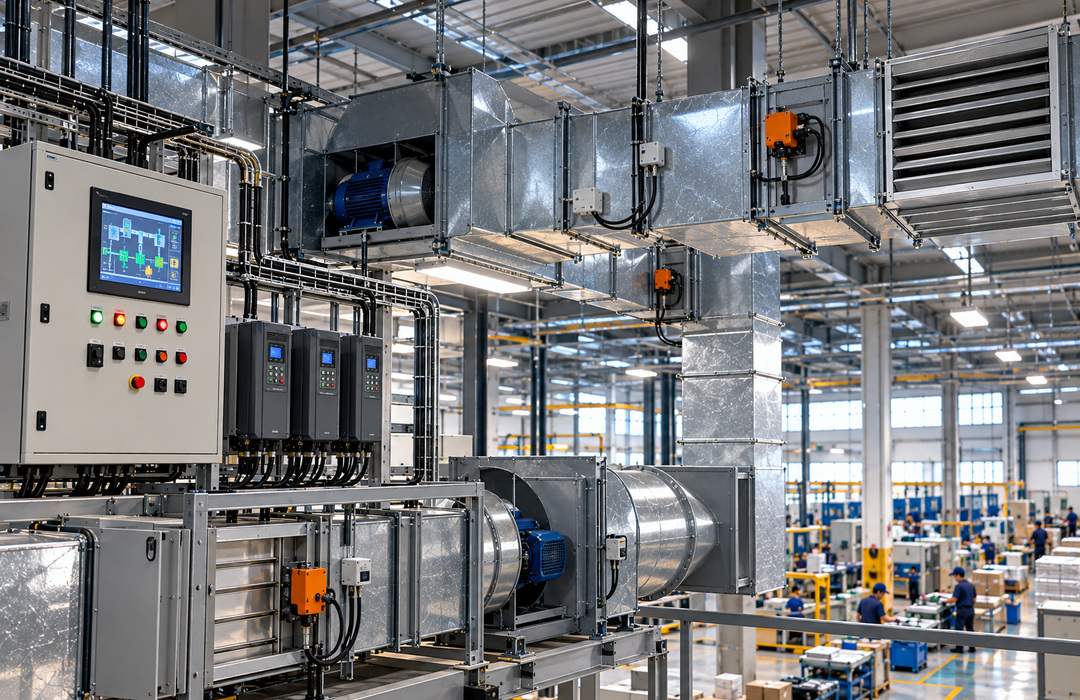
Commercial Ventilation Control Systems Philippines are mechanical and building-control solutions used to manage how ventilation air is supplied, circulated, and exhausted across commercial and industrial facilities. Instead of relying only on manual fan operation, these systems can coordinate ventilation equipment according to schedules, environmental conditions, occupancy, or predefined operating logic.
A typical system may include supply fans, exhaust fans, dampers, variable-speed drives, sensors, control panels, actuators, and interfaces with broader HVAC or building management platforms.
Depending on the application, the controls may regulate airflow continuously or adjust equipment only when certain conditions are detected. Commercial ventilation controls can be applied in offices, hospitals, hotels, warehouses, industrial facilities, equipment rooms, parking areas, and other spaces that require managed airflow.
Foxcon Total Solutions, Inc. provides mechanical and HVAC-related solutions that can support coordinated ventilation environments.
Why Choose Commercial Ventilation Control Systems?
Different spaces within the same building can have very different ventilation requirements. A crowded office, enclosed equipment room, storage area, or industrial workspace may each require a different amount of outdoor air, exhaust, or circulation depending on occupancy, heat generation, contaminants, and operating conditions.
Commercial Ventilation Control Systems Philippines provide a structured way to manage these differences. Instead of running all ventilation equipment continuously at the same output, controls can operate fans and dampers according to schedules or monitored conditions where appropriate.
Automated control can also help facility personnel respond to changing conditions more consistently. Sensors may provide information such as temperature, humidity, occupancy-related indicators, pressure, or air-quality measurements, while the control system adjusts compatible equipment according to the intended strategy.
Ventilation control can complement Commercial HVAC Solutions, Building Management Systems, Environmental Monitoring Systems, Data Center Cooling Solutions, Mechanical Ventilation Systems, and other building mechanical infrastructure.
How Commercial Ventilation Control Systems Work
A ventilation control system receives input from sensors, switches, timers, schedules, or a Building Management System and uses that information to control compatible mechanical equipment. The operating sequence is defined according to the purpose of the space and the mechanical design.
For example, a controller may start an exhaust fan during occupied hours, open a damper when ventilation is required, or adjust fan speed through a variable-frequency drive. In more advanced systems, airflow may be adjusted according to monitored conditions rather than remaining fixed throughout the day.
Sensors can provide data from selected spaces, while controllers compare those values against programmed setpoints or operating logic. The resulting commands may control fans, dampers, actuators, alarms, or other connected equipment.
The appropriate configuration depends on room size, occupancy, airflow demand, duct layout, fan capacity, system resistance, environmental conditions, and the level of automation required. Controls should therefore be designed around the complete airflow system rather than treated as an isolated electrical function.
Commercial Ventilation Control Systems Safety & Trust
Ventilation controls should be coordinated with the mechanical design of the facility. Fans, dampers, sensors, ductwork, actuators, controllers, and other components need to operate together correctly for the intended airflow path to be achieved.
Sensor placement is especially important because a control system can make the wrong decision if the measured condition does not accurately represent the occupied or critical area. Sensors placed near supply diffusers, heat sources, doors, or other unrepresentative locations may provide misleading information.
Where ventilation interacts with fire and life-safety functions, control sequences must be coordinated carefully with the broader building design. Normal ventilation operation may need to change during certain emergency conditions, depending on the approved system strategy and applicable requirements.
Foxcon Total Solutions, Inc. supports mechanical projects through Engineering and Design, Supply and Installation, Project Implementation, Testing and Commissioning, Preventive Maintenance, and related technical services.
Commercial Ventilation Control Systems Tips
-
Assess each space separately. Different rooms may have different ventilation needs.
-
Position sensors carefully. Avoid locations that do not represent the actual room conditions.
-
Define operating schedules. Match ventilation operation to occupancy and facility use where appropriate.
-
Check damper movement. A control signal is not useful if the damper is physically stuck.
-
Verify fan capacity. Controls cannot compensate for equipment that is undersized for the required airflow.
-
Coordinate with HVAC systems. Ventilation and temperature control often affect each other.
-
Review variable-speed settings. Make sure minimum and maximum speeds remain suitable for the intended airflow.
-
Test alarm conditions. Confirm that abnormal equipment or sensor conditions are reported where required.
-
Review controls after renovations. Layout and occupancy changes can alter ventilation requirements.
Verify the Airflow Response, Not Just the Control Signal
A control panel can show that a fan has been commanded to start while the actual space still receives insufficient airflow. The problem may be a failed actuator, blocked filter, damaged belt, closed damper, duct restriction, incorrect fan rotation, or another mechanical issue.
Commissioning should therefore verify the physical response of the ventilation system rather than checking only controller outputs. If a damper is commanded to open, its actual position should be confirmed. If fan speed increases, the resulting airflow or pressure condition should respond as expected.
This becomes especially important in variable-speed systems because a percentage shown on the control interface does not directly prove that the required airflow is being delivered to the intended area.
Testing the full sequence from sensor input to mechanical airflow helps distinguish a control problem from an equipment, ductwork, or balancing problem.
Frequently Asked Questions
What is a Commercial Ventilation Control System?
A Commercial Ventilation Control System manages compatible fans, dampers, actuators, sensors, and other mechanical equipment to regulate airflow within designated building areas.
Is ventilation control the same as air conditioning?
No. Ventilation primarily manages air movement and exchange, while air-conditioning systems typically manage temperature and may also control humidity and other environmental conditions. They can operate together as part of an HVAC system.
Can ventilation systems operate automatically?
Yes. Compatible controls can operate fans, dampers, and related equipment according to schedules, sensor information, occupancy conditions, or predefined control logic.
Can ventilation controls connect to a Building Management System?
Yes, when the selected equipment and communication interfaces are compatible. This can allow centralized monitoring, scheduling, alarms, and control.
What sensors can be used with ventilation controls?
Depending on the application, systems may use temperature, humidity, pressure, occupancy-related, carbon dioxide, air-quality, or other compatible sensors.
Can ventilation controls reduce unnecessary fan operation?
Potentially, yes. Where appropriate, scheduled or demand-based control can reduce unnecessary operation compared with running ventilation equipment continuously at full output.
Where are Commercial Ventilation Control Systems used?
They can be used in offices, commercial buildings, hospitals, hotels, warehouses, industrial facilities, equipment rooms, parking areas, and other environments requiring managed airflow.
Should ventilation control equipment be maintained?
Yes. Fans, dampers, actuators, sensors, controllers, filters, and other associated mechanical components should be included in appropriate inspection and preventive maintenance activities.
Check the Sensor Location Before Changing the Setpoint
When a ventilation system appears to respond too early, too late, or too aggressively, the programmed setpoint is not always the problem. The sensor may simply be measuring conditions that do not represent the area the control system is intended to manage.
For example, a sensor located directly beside a supply-air outlet may read cooler or cleaner air than the rest of the room, while one near equipment may detect a higher temperature than the occupied space. Adjusting the setpoint around a poorly located sensor can create new control problems without fixing the original issue.
Technical teams should compare the sensor reading with conditions at representative locations before changing control logic. Sensor calibration, placement, airflow patterns, and nearby heat or contaminant sources should all be reviewed.
Correcting the measurement point first helps ensure that automation decisions are based on useful information rather than compensating for a misleading input.
Control the Ventilation Around Actual Airflow Requirements
A properly planned Commercial Ventilation Control Systems Philippines environment should coordinate sensors, fans, dampers, variable-speed equipment, ductwork, schedules, control logic, HVAC systems, and Building Management Systems as one complete mechanical strategy.
Foxcon Total Solutions, Inc. can support ventilation control planning, mechanical system implementation, control integration, testing, commissioning, documentation, and preventive maintenance for commercial and industrial facilities.
📞 Contact us today to discuss your commercial ventilation control and mechanical system requirements.
📍 Serving businesses in Cebu, Metro Manila, and nationwide.
🌐 Explore Foxcon’s solutions to learn more about our services.
References
-
Amphenol Sensors – Commercial Ventilation Controls Applications https://amphenol-sensors.com/commercial-ventilation-controls-applications
-
Ventilation Philippines – Ventilation Solutions https://ventilationph.com/
-
Cube Controls – Types of Industrial Ventilation Systems https://www.cubecontrols.co.uk/types-of-industrial-ventilation-systems/
-
Inergy Group – Commercial Ventilation Systems Guide https://www.inergygroup.co.uk/blogs/commercial-ventilation-systems-uk-guide/
-
RVT Group Australia – What Is an Industrial Ventilation System? https://rvtgroup.com.au/insights-resources/news/what-is-an-industrial-ventilation-system/