


News and Events
Lightning Protection Systems Philippines: Protecting Buildings and Electrical Infrastructure
What Are Lightning Protection Systems?
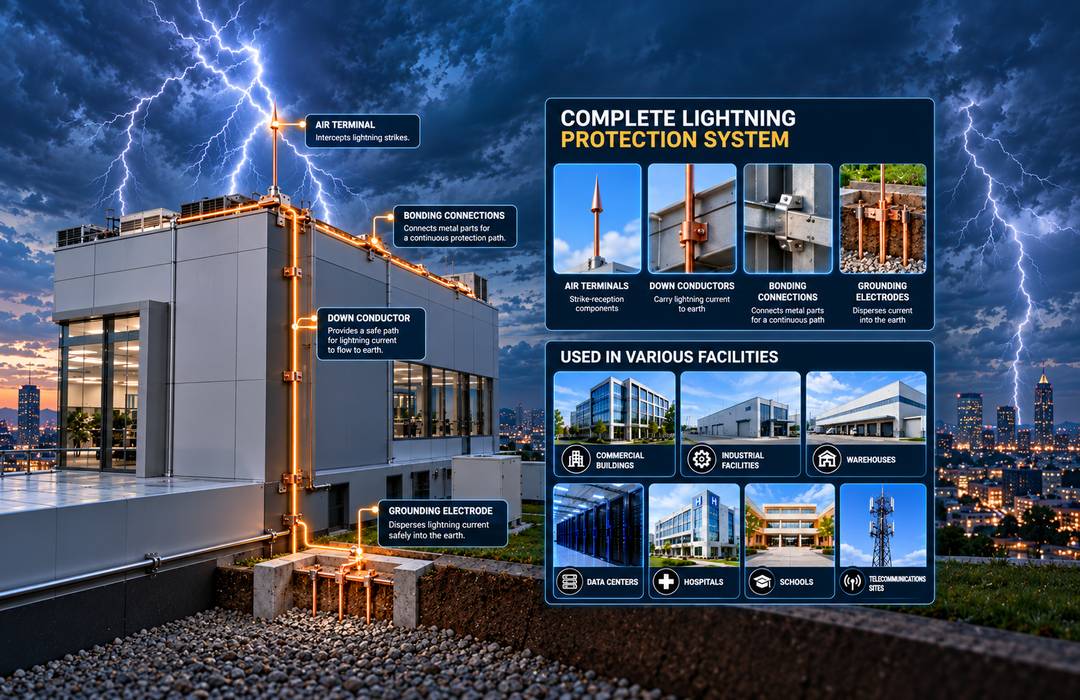
Lightning Protection Systems Philippines are engineered safety systems designed to help protect buildings and electrical infrastructure from the effects of direct lightning strikes. Their purpose is to intercept lightning and provide a controlled conductive path toward earth rather than allowing high current to travel unpredictably through structural components, wiring, equipment, or other conductive parts of a facility.
A typical system may include air terminals or strike-reception components, down conductors, bonding connections, grounding electrodes, and related hardware. These components work together as one protection path, and their arrangement depends on the structure, roof configuration, building height, materials, site conditions, and project requirements.
Lightning protection may be used in commercial buildings, industrial facilities, warehouses, data centers, hospitals, schools, telecommunications sites, and other facilities containing important electrical and electronic systems.
Foxcon Total Solutions, Inc. provides electrical works and related infrastructure services that can support safer and more reliable commercial and industrial environments.
Why Choose Lightning Protection Systems?
Lightning can introduce very high electrical current into a building or nearby infrastructure. Without a planned protection path, that current may travel through conductive building components, electrical systems, communication cabling, or connected equipment, increasing the risk of damage and unsafe voltage differences.
Lightning Protection Systems Philippines provide a structured approach to intercepting and conducting lightning current toward earth. The goal is not to prevent lightning from occurring, but to control how the resulting current is carried through and away from the structure.
This is particularly important for facilities containing servers, network equipment, CCTV systems, access control devices, communication infrastructure, power distribution equipment, automation systems, and other electronics that may also be vulnerable to lightning-related electrical disturbances.
Lightning protection should therefore be coordinated with Grounding and Earthing Systems, Surge Protection Systems, Electrical Panel Solutions, Data Center Infrastructure, Backup Power Systems, and other electrical protection technologies rather than treated as an isolated installation.
How Lightning Protection Systems Work
A lightning protection system begins by providing designated points intended to intercept a lightning strike. Air terminals or other suitable strike-reception components are positioned according to the protection design and connected to conductive paths running toward the grounding system.
Down conductors then carry the lightning current from the upper part of the structure toward earth. Their routing, connections, and continuity are important because the system must provide a deliberate path capable of handling the very high current associated with a strike.
Grounding electrodes disperse current into the earth, while bonding connects appropriate conductive parts together to reduce dangerous potential differences during a lightning event. Poor bonding can allow significant voltage differences to develop between nearby metal systems even when a grounding path is present.
The design should also be coordinated with surge protection because the external lightning protection system and internal surge protection serve different functions. The lightning protection system manages the strike current path, while surge protective devices help limit transient overvoltages entering electrical, control, communication, or other connected systems.
Lightning Protection Systems Safety & Trust
Lightning protection is a specialized electrical safety system and should be designed, installed, inspected, and maintained by qualified personnel according to applicable standards, project requirements, and building conditions. Adding individual air terminals without a complete conductive, bonding, and grounding path does not create a complete lightning protection system.
Connections, conductors, supports, bonding points, and grounding components should remain mechanically secure and electrically continuous. Corrosion, loose connections, damaged conductors, roof work, structural modifications, or changes to rooftop equipment can affect the integrity of the protection path.
Building alterations deserve particular attention. New antennas, solar equipment, mechanical units, communication systems, metal structures, or roof extensions may change the protection requirements and should be reviewed rather than installed without considering the existing lightning protection layout.
Foxcon Total Solutions, Inc. supports electrical projects through Engineering and Design, Supply and Installation, Project Implementation, Electrical Testing and Commissioning, Preventive Maintenance, and related technical services.
Lightning Protection Systems Tips
-
Include lightning protection early in design. Coordination is easier before roofing, electrical, and mechanical installations are completed.
-
Treat the system as one complete path. Air terminals, conductors, bonding, and grounding should work together.
-
Coordinate with surge protection. Structural lightning protection alone does not protect every connected electronic device from transient overvoltage.
-
Inspect exposed conductors and connections. Look for corrosion, mechanical damage, loose fittings, and altered routing.
-
Review rooftop modifications. New equipment can affect the original protection arrangement.
-
Maintain accurate grounding records. Document electrode locations, conductor routes, and bonding points.
-
Avoid unnecessary sharp routing changes. Conductors should follow the intended protection design without avoidable routing problems.
-
Inspect after major construction work. Roof repairs and renovations can accidentally damage protection components.
-
Include the system in preventive maintenance. Lightning protection should not be installed and then ignored.
Check the Complete Lightning Current Path, Not Just the Air Terminal
A visible air terminal on a roof does not by itself confirm that a building has an effective lightning protection system. The strike-reception component is only the beginning of the path.
The current still has to travel through properly connected conductors, bonding points, and grounding infrastructure before it can be dispersed into the earth. A disconnected down conductor, damaged joint, corroded bonding connection, or altered grounding arrangement can weaken the intended protection path even if the rooftop components appear normal.
Inspection should therefore trace the system from the strike-reception points through the down conductors and bonding network to the grounding termination. Areas that have been renovated or concealed by later construction deserve particular attention because changes may not be obvious from a rooftop inspection alone.
This whole-path approach is more useful than checking individual components in isolation. Lightning protection depends on continuity and coordination across the entire system.
Frequently Asked Questions
What is a Lightning Protection System?
A Lightning Protection System is an engineered system designed to intercept a direct lightning strike and provide a controlled path for the resulting current to travel toward earth.
What components are commonly included?
Depending on the design, components may include air terminals or strike-reception devices, down conductors, bonding connections, grounding electrodes, supports, connectors, and related protection hardware.
Is lightning protection the same as surge protection?
No. Lightning protection manages the physical path of lightning current through and around a structure, while surge protection helps limit transient overvoltages that may reach electrical and electronic equipment.
Does a lightning rod attract lightning?
A lightning protection air terminal is intended to provide a preferred interception point when a strike occurs within the protected arrangement. Its purpose is not to create thunderstorms or generally attract lightning from distant locations.
Why is bonding important?
Bonding helps reduce dangerous potential differences between conductive parts during a lightning event and provides a more controlled path for current.
Why is grounding important?
Grounding provides the final path through which lightning current can be dispersed into the earth as part of the overall protection system.
Can an existing building be fitted with lightning protection?
Yes. Existing buildings can be assessed, and a suitable system may be installed or upgraded based on the structure, site conditions, existing electrical infrastructure, and project requirements.
Should Lightning Protection Systems be inspected regularly?
Yes. Periodic inspection helps identify damaged conductors, loose connections, corrosion, altered rooftop equipment, and other changes that could affect the system.
Protect the Whole Electrical Path, Not Just the Roof
A properly planned Lightning Protection Systems Philippines installation should combine strike interception, current conduction, bonding, grounding, and coordination with surge protection. Each part contributes to how safely lightning current is managed around the building and its electrical infrastructure.
Foxcon Total Solutions, Inc. can support lightning protection planning, grounding coordination, electrical installation, testing, commissioning, and preventive maintenance for commercial and industrial facilities.
📞 Contact us today to discuss your lightning protection and electrical infrastructure requirements.
📍 Serving businesses in Cebu, Metro Manila, and nationwide.
🌐 Explore Foxcon’s solutions to learn more about our services.
References
1. Trilpeak – What Is a Lightning Protection System?
https://trilpeak.com/what-is-lightning-protection-system/
2. ECLE – What Is Lightning Protection?
https://ecle.biz/what-is-lightning-protection/
3. Gandian – Different Types of Lightning Protection Systems
https://cngandian.com/different-types-of-lightning-protection-systems/
4. Kingsmill Industries – Lightning Protection Systems
https://kingsmillindustries.com/lightning-protection-systems/
5. Wisconsin Public Service – Lightning Protection Guidance
https://www.wisconsinpublicservice.com/partners/agriculture/farm-lightning