


News and Events
Power Quality Monitoring Systems Philippines: Identifying Electrical Conditions That Affect Critical Equipment
What Are Power Quality Monitoring Systems?
Power Quality Monitoring Systems Philippines are electrical monitoring solutions designed to measure, record, and analyze conditions within a facility’s electrical supply. They help technical teams identify voltage variations, frequency changes, waveform disturbances, and other electrical conditions that may affect sensitive equipment, electrical infrastructure, and facility operations.
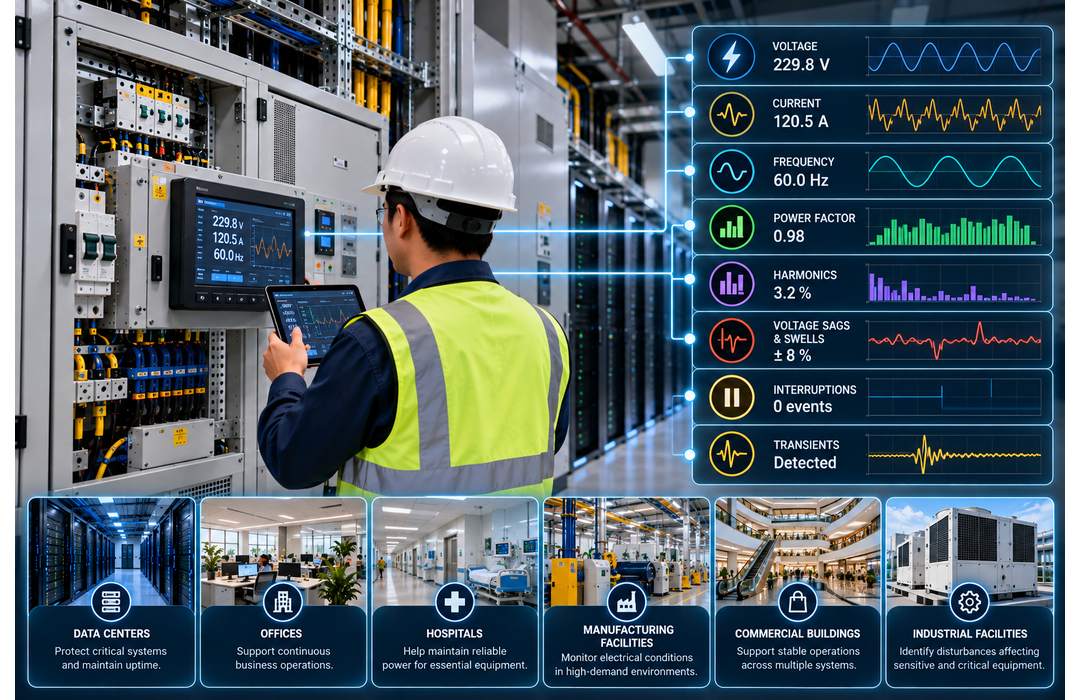
Depending on the monitoring equipment, the system may measure voltage, current, frequency, power factor, harmonics, voltage sags and swells, interruptions, transients, and other power-quality parameters. Recording these conditions over time gives technical personnel more information than a single electrical measurement taken after a problem has already occurred.
Power quality monitoring can be useful in commercial buildings, industrial facilities, hospitals, data centers, offices, manufacturing environments, and other facilities that rely on sensitive or continuously operating electrical equipment.
Foxcon Total Solutions, Inc. provides electrical works and related infrastructure services that can support properly monitored power environments.
Why Choose Power Quality Monitoring Systems?
Modern facilities rely heavily on electronic and digitally controlled equipment. Servers, network devices, UPS systems, security technologies, communication equipment, building controls, variable-frequency drives, and industrial machinery can all be affected when electrical conditions move outside their intended operating range.
Power Quality Monitoring Systems provide visibility into disturbances that may be intermittent and difficult to identify through routine inspection. If equipment unexpectedly resets, protective devices operate, a UPS repeatedly transfers to battery, or certain systems experience unexplained interruptions, recorded electrical information can help technical teams compare those incidents with what was happening on the electrical supply at the same time.
Historical information is also valuable for identifying recurring patterns. Rather than investigating only after a failure, facility teams can review when disturbances occurred, how long they lasted, which part of the electrical system was affected, and whether the condition corresponds with equipment startup, load changes, utility events, or other operating conditions.
Power quality monitoring can complement Power Monitoring Systems, Electrical Load Management Systems, UPS Solutions, Surge Protection Systems, Main Distribution Boards, Generator Systems, and Data Center Power Distribution infrastructure.
How Power Quality Monitoring Systems Work
Power quality monitoring equipment is installed at selected locations within the electrical distribution system. Depending on the objective, monitoring may be performed at the incoming electrical supply, Main Distribution Board, subpanels, branch circuits, UPS inputs and outputs, generator-supported circuits, or near particularly sensitive equipment.
Meters and sensors collect electrical measurements and send the information to compatible monitoring equipment or software. More advanced power quality monitors can capture events such as voltage sags, swells, interruptions, harmonics, frequency variations, and transient conditions in addition to normal voltage and current measurements.
The monitoring platform records data over time so technical teams can review trends and investigate specific events. Where supported, alarms or notifications may be configured when selected parameters move outside established thresholds, helping personnel identify conditions that require further investigation.
The correct monitoring locations depend on the electrical architecture and the problem being investigated. Monitoring only at the main supply may show that a disturbance occurred, but additional measurement points may be required to determine whether the source is upstream from the facility or associated with downstream equipment and loads.
Power Quality Monitoring Systems Safety & Trust
Power quality monitoring equipment interfaces with energized electrical infrastructure, so installation and configuration should be handled by qualified personnel using equipment appropriate for the system voltage, measurement location, and intended application. Incorrect connections, unsuitable measurement devices, or improperly configured sensors can produce inaccurate readings and may introduce unnecessary electrical risk.
Measurement configuration is equally important. Current-transformer ratios, voltage connections, time settings, monitoring thresholds, and equipment identification should be verified so recorded events can be associated with the correct circuits and operating conditions.
Power-quality data should also be interpreted in context. A single voltage variation or harmonic measurement does not necessarily identify the cause of an equipment problem. Technical personnel should compare monitoring results with equipment behavior, load changes, system configuration, maintenance records, and other electrical information before drawing conclusions.
Foxcon Total Solutions, Inc. supports electrical projects through Engineering and Design, Supply and Installation, Project Implementation, Electrical Testing and Commissioning, Preventive Maintenance, and related technical services.
Power Quality Monitoring Systems Tips
-
Define the problem before selecting monitoring points. Determine whether the concern involves a particular circuit, equipment group, or the incoming electrical supply.
-
Monitor critical electrical locations. Focus on areas serving sensitive or high-value equipment.
-
Record more than basic voltage. Harmonics, sags, swells, interruptions, and frequency may be relevant depending on the issue.
-
Verify meter configuration. Incorrect sensor ratios or circuit assignments can make otherwise accurate measurements misleading.
-
Synchronize monitoring time. Accurate timestamps make it easier to compare electrical events with equipment alarms and operating logs.
-
Review historical trends. Intermittent problems may only become clear after several days or weeks of recorded data.
-
Compare events with operating conditions. Equipment startup, switching, generator operation, and large load changes may provide important context.
-
Reassess monitoring after electrical changes. New equipment or distribution modifications can change the facility’s power-quality profile.
Correlate Electrical Events With Equipment Problems Before Replacing Hardware
When critical equipment repeatedly resets or operates unpredictably, it can be tempting to assume that the device itself is failing. However, replacing equipment without checking the electrical conditions supplying it may leave the original problem unresolved.
A better troubleshooting approach is to compare equipment incidents with time-stamped power-quality data. For example, if a server, controller, UPS, or communication system reports an interruption at a particular time, monitoring records can be checked for voltage sags, interruptions, frequency deviations, or other disturbances during the same period.
Monitoring at more than one electrical point can provide additional context. If a disturbance appears at the main supply and downstream panels at the same time, the investigation may follow a different path than if the condition appears only on one branch circuit serving a particular group of loads.
Power quality monitoring does not automatically identify every root cause, but it provides evidence that can make troubleshooting more systematic. The objective is to understand what the electrical system was doing when the problem occurred before replacing equipment or modifying the infrastructure.
Frequently Asked Questions
What is a Power Quality Monitoring System?
A Power Quality Monitoring System measures and records electrical conditions over time so technical personnel can evaluate how the electrical supply is behaving and investigate disturbances that may affect connected equipment.
What can a Power Quality Monitoring System measure?
Depending on the equipment, measurements may include voltage, current, frequency, power factor, harmonics, voltage sags and swells, interruptions, transients, and other electrical parameters.
What is a voltage sag?
A voltage sag is a temporary reduction in RMS voltage. Depending on its magnitude, duration, and the connected equipment, it may contribute to resets, contactor dropouts, UPS operation, or other equipment responses.
What is a voltage swell?
A voltage swell is a temporary increase in RMS voltage above the normal operating level. Monitoring can help determine when it occurred and how long the condition lasted.
Why are harmonics monitored?
Harmonics are distortions in voltage or current waveforms that can be associated with nonlinear electrical loads. Excessive harmonic distortion may affect some equipment and should be evaluated according to the electrical system and applicable requirements.
Is Power Quality Monitoring the same as general Power Monitoring?
Not exactly. General power monitoring often focuses on consumption, demand, and electrical loading, while power quality monitoring places greater emphasis on voltage characteristics and disturbances that may affect electrical equipment.
Can Power Quality Monitoring Systems provide alerts?
Yes, depending on the monitoring platform. Alerts may be configured for selected electrical parameters or events when predefined limits are exceeded.
Where should power quality monitoring equipment be installed?
The monitoring point depends on the investigation. Equipment may be installed at the incoming supply, distribution boards, selected circuits, UPS systems, generator-supported infrastructure, or near critical loads.
Identify the Electrical Condition Before Treating the Equipment as the Problem
A properly planned Power Quality Monitoring Systems Philippines solution can help organizations move from assumptions to recorded electrical evidence when investigating equipment interruptions, voltage concerns, and other recurring power issues. The monitoring strategy should be based on the facility’s electrical architecture, critical equipment, known symptoms, and the type of disturbance that needs to be captured.
Foxcon Total Solutions, Inc. can support power-quality assessment, monitoring equipment integration, electrical infrastructure planning, installation, testing, commissioning, and preventive maintenance for commercial and industrial facilities.
📞 Contact us today to discuss your power quality monitoring and electrical infrastructure requirements.
📍 Serving businesses in Cebu, Metro Manila, and nationwide.
🌐 Explore Foxcon’s solutions to learn more about our services.
References
1. Schweitzer Engineering Laboratories – Power Quality Monitoring Reference
https://selinc.com/api/download/5482
2. ABB – Power Quality Monitoring
https://new.abb.com/low-voltage/launches/power-quality/power-quality-monitoring
3. Quality Energy – Benefits of Power Quality Monitoring
https://www.qualityenergy.com.au/benefits-of-power-quality-monitoring
4. IEEE Xplore – Power Quality Monitoring Research
https://ieeexplore.ieee.org/document/7093825
5. Analog Devices – Power Quality Monitoring: The Importance of Compliant Measurements
https://www.analog.com/en/resources/analog-dialogue/articles/power-quality-monitoring-part-1-the-importance-of-compliant-power-quality-measurements.html