


News and Events
Telecommunications Room Solutions Philippines: Organizing Network and Communication Infrastructure
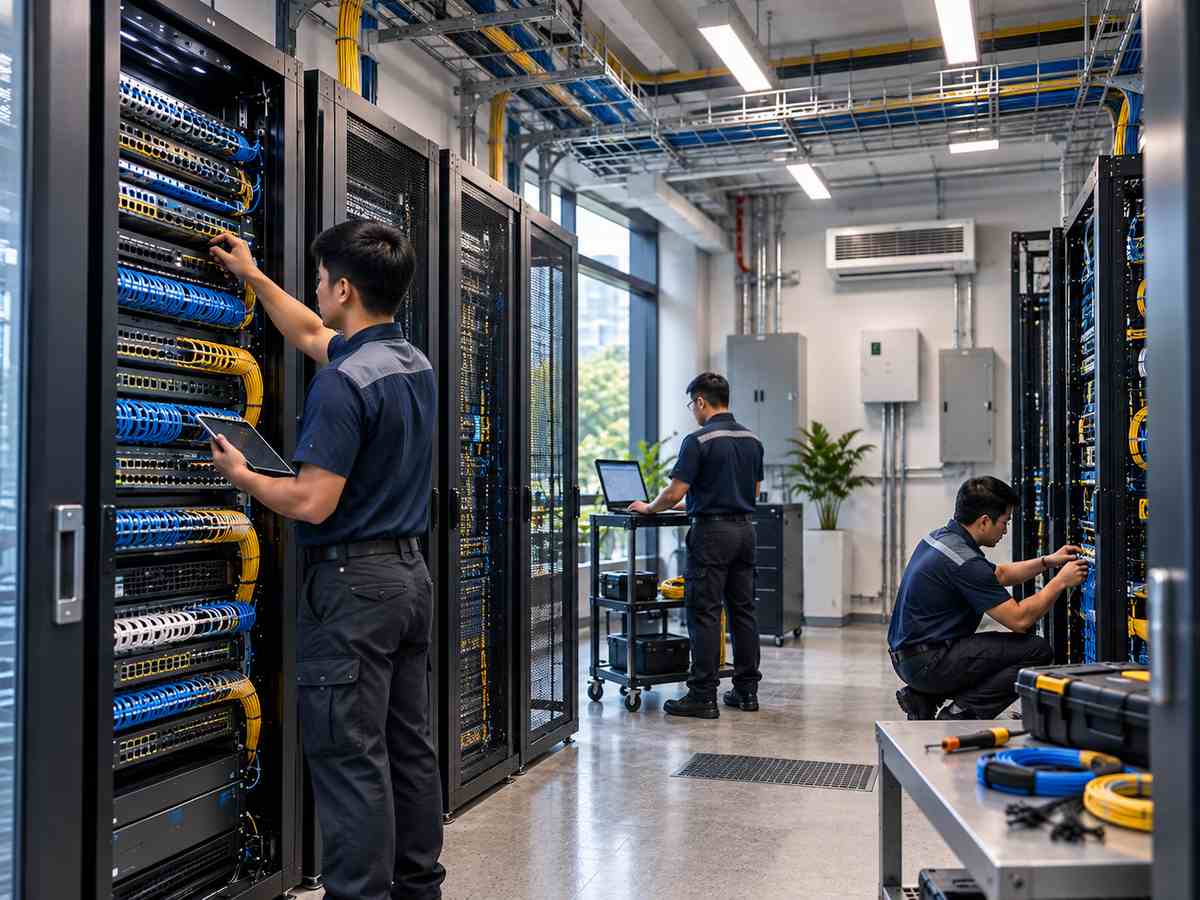
📡 What Are Telecommunications Room Solutions?
Telecommunications Room Solutions Philippines provide the dedicated spaces and supporting infrastructure used to organize network cabling, telecommunications equipment, patch panels, network switches, fiber connections, and other communication systems within a building.
A telecommunications room, often called a TR, serves as a distribution point between the building’s backbone cabling and the horizontal cabling that connects work areas, wireless access points, IP cameras, access control devices, phones, and other network-connected equipment.
Depending on the size and layout of the facility, a building may contain one main equipment room and several telecommunications rooms located on different floors or areas.
Foxcon Total Solutions, Inc. provides Telecommunications Room Solutions for commercial buildings, corporate offices, hospitals, hotels, educational institutions, manufacturing facilities, government facilities, and other projects requiring organized network and communication infrastructure.
🏢 Why Choose Telecommunications Room Solutions?
Network performance depends on more than switches, routers, and internet service. The physical environment where network equipment and cabling are installed also affects reliability, maintenance, and future expansion.
A properly planned telecommunications room provides organized space for racks, cabinets, patch panels, fiber enclosures, network switches, cable management, power distribution, and other communication equipment.
Centralizing these components makes connections easier to identify and maintain. It also gives technicians a controlled location for troubleshooting, testing, equipment replacement, and network expansion.
Telecommunications rooms also help manage cable distances. Horizontal copper cabling has distance limitations, so the location of the telecommunications room should be considered together with the work areas and devices it will serve.
⚙️ How Telecommunications Room Solutions Work
The planning process begins by reviewing the building layout, network requirements, equipment quantities, cable routes, backbone connections, and the locations of users and connected devices.
A telecommunications room may contain:
● Equipment racks or cabinets
● Copper patch panels
● Fiber optic enclosures
● Network switches
● Routers and related equipment
● Cable managers
● Power distribution units
● Grounding and bonding provisions where required
● Backbone cabling
● Horizontal cabling terminations
● Labels and documentation
Backbone cabling connects telecommunications rooms with the main equipment room or other distribution areas. Horizontal cabling then extends from the telecommunications room to network outlets and connected devices within the service area.
Cables are terminated on patch panels or fiber enclosures and connected to active network equipment using patch cords. Proper labeling allows technicians to identify connections between equipment, patch panels, outlets, and devices.
🛡️ Telecommunications Room Solutions Safety & Trust
Telecommunications rooms should provide a suitable environment for network and communication equipment. Heat, dust, moisture, unauthorized access, poor cable management, and insufficient power can affect equipment reliability and maintenance.
Room layout should allow technicians to access the front and rear of racks or cabinets where required. Cables should be routed and supported so they do not obstruct equipment ventilation or create unnecessary stress on connectors.
Power requirements should also be coordinated with the equipment that will be installed. Network switches, routers, servers, controllers, and other active devices may require dedicated power provisions, UPS systems, or other supporting infrastructure depending on project requirements.
Access to telecommunications rooms should be controlled because network equipment and cabling can provide access to important business systems.
Documentation is also important. Rack layouts, patch panel schedules, cable identifiers, fiber records, network diagrams, and testing results should be maintained so technicians can understand the installed infrastructure.
💡 Telecommunications Room Solutions Tips
● Locate telecommunications rooms based on the areas and devices they need to serve.
● Review horizontal cable distance limitations during planning.
● Allow sufficient rack or cabinet capacity for current equipment and reasonable future expansion.
● Provide organized vertical and horizontal cable management.
● Keep copper and fiber terminations clearly labeled.
● Coordinate power requirements for active network equipment.
● Consider UPS requirements for critical network devices.
● Maintain appropriate room ventilation or cooling where required.
● Restrict unauthorized access to telecommunications spaces.
● Keep equipment rooms free from unnecessary storage.
● Document rack layouts, patch panels, cable routes, and network connections.
● Test copper and fiber cabling before final turnover.
📐 Design the Room Around Cable Distance, Not Just Available Floor Space
A telecommunications room should not be placed only where unused floor space happens to be available. Its location affects the cable routes and distances required to connect network devices throughout the building.
Consider a large office floor with workstations, wireless access points, CCTV cameras, access control devices, printers, and other network equipment. If the telecommunications room is located too far from the areas it serves, horizontal copper cable runs may become unnecessarily long or exceed the design limitations of the cabling system.
The same issue can occur when one telecommunications room is expected to serve an area that would be better supported by multiple distribution points.
Planning the room locations together with the network layout allows designers to consider cable distance, pathway capacity, equipment requirements, and future expansion before construction limits the available options.
This becomes especially important in multi-floor buildings, large commercial spaces, hospitals, manufacturing facilities, campuses, and other properties where network devices may be distributed across wide areas.
❓ Frequently Asked Questions
What is a telecommunications room?
A telecommunications room is a dedicated space used to house network and communication equipment, cable terminations, patch panels, fiber connections, switches, and related infrastructure serving a specific area of a building.
What equipment is installed in a telecommunications room?
Equipment may include racks, cabinets, copper patch panels, fiber enclosures, network switches, routers, cable managers, power distribution units, and other communication equipment.
How many telecommunications rooms does a building need?
The number depends on the building size, floor layout, cable distances, network requirements, and the locations of connected devices.
Why is the location of a telecommunications room important?
The room location affects horizontal cable distances, cable routing, pathway requirements, equipment access, and the areas that can be efficiently served.
What is the difference between a telecommunications room and an equipment room?
A telecommunications room typically serves a specific floor or area and provides connections between backbone and horizontal cabling. An equipment room may contain larger or more centralized telecommunications and network equipment serving the building or facility.
Do telecommunications rooms need cooling?
Cooling or ventilation requirements depend on the amount and type of active equipment installed, the room environment, and manufacturer requirements.
Should telecommunications rooms be secured?
Yes. Access should normally be limited to authorized personnel because the room contains network equipment, communication infrastructure, and connections to business systems.
Can existing telecommunications rooms be upgraded?
Yes. Existing rooms can be assessed for rack capacity, cable management, power, cooling, equipment condition, labeling, fiber and copper infrastructure, and future expansion requirements.
🚀 Plan the Telecommunications Room Before the Cable Routes Are Finalized
Build organized network and communication infrastructure with professionally planned Telecommunications Room Solutions Philippines. Foxcon Total Solutions, Inc. can support projects through room planning, rack and cabinet installation, structured cabling, fiber and copper termination, testing, labeling, documentation, and network infrastructure deployment.
📞 Contact us today to discuss your telecommunications room requirements.
📍 Serving businesses in Cebu, Metro Manila, and nationwide.
🌐 Explore Foxcon’s solutions to learn more about our services.