


News and Events
Surge Protection Systems Philippines: Protecting Critical Equipment from Electrical Disturbances
What Are Surge Protection Systems?
Surge Protection Systems Philippines are electrical protection solutions designed to limit transient overvoltages before excessive electrical energy reaches sensitive equipment.
A voltage surge, also called a transient overvoltage, is a short-duration increase in voltage that can occur because of electrical switching, equipment operation, power-system disturbances, or lightning-related events. Although these disturbances may last only a short time, they can place additional electrical stress on connected equipment.
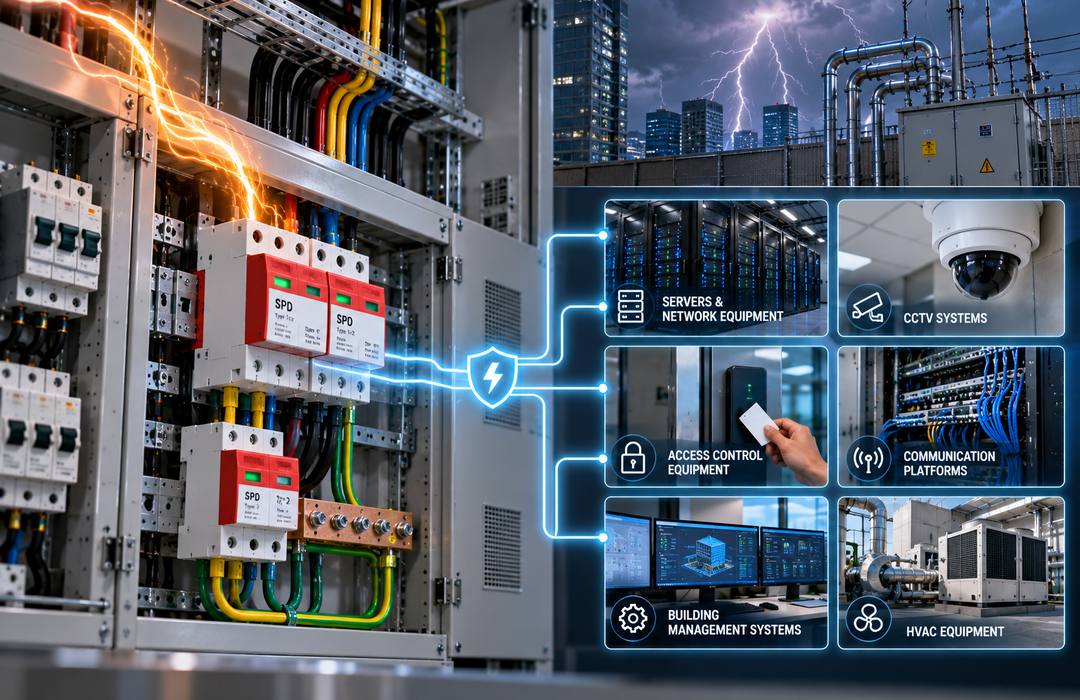
Commercial and industrial facilities increasingly depend on sensitive electronics such as servers, network switches, CCTV systems, access control equipment, communication platforms, building controls, and other digital technologies.
Foxcon Total Solutions, Inc. provides electrical works and related power infrastructure solutions that can support surge protection as part of a broader electrical protection strategy for commercial and industrial facilities.
Why Choose Surge Protection Systems?
Modern business operations depend heavily on electronic equipment that remains connected to electrical power throughout the day. Transient overvoltages can originate outside or inside a facility. Lightning-related disturbances may enter through electrical services or connected conductors, while internal switching events involving motors, transformers, and other electrical loads can also produce transient conditions.
Surge Protection Devices, commonly called SPDs, are designed to limit these transient voltages and divert surge current away from protected equipment.
For larger facilities, surge protection may be applied at several points in the electrical distribution system rather than relying on one device. This coordinated approach can provide protection closer to the incoming supply, at downstream distribution panels, and near selected sensitive equipment, depending on the electrical design.
Surge protection should therefore be considered alongside Grounding and Earthing Systems, Electrical Panel Solutions, Power Distribution Systems, UPS Solutions, Backup Power Systems, and Data Center Power Distribution.
How Surge Protection Systems Work
During normal electrical conditions, an SPD does not significantly interfere with the operation of the connected circuit. When a transient voltage exceeds the device’s designed operating threshold, the SPD responds by limiting the voltage and diverting surge current through the intended electrical path. Once the transient condition passes, the device returns to its normal state if it remains serviceable.
Different SPDs may be installed at different locations within an electrical system. Common classifications include:
-
Type 1 SPD – generally installed at or near the origin of the electrical installation and designed for specific high-energy surge conditions.
-
Type 2 SPD – commonly installed at distribution boards to provide protection against transient overvoltages within the distribution system.
-
Type 3 SPD – typically installed closer to sensitive equipment and used as an additional level of protection.
The exact classification, location, and coordination of SPDs should be determined according to the electrical system and applicable requirements rather than selecting devices based only on their type number.
Surge protection can also extend beyond AC power circuits. Depending on the facility, communication, network, control, or other signal lines may require appropriate protection because transient energy can enter equipment through more than one conductive path.
Surge Protection Systems Safety & Trust
Surge protection is most effective when it is treated as part of the complete electrical infrastructure. The performance of an SPD can be affected by device selection, grounding and bonding, conductor routing, installation location, connection length, system voltage, and the characteristics of the electrical distribution system.
Long or poorly arranged connecting conductors can add impedance and affect the voltage experienced by downstream equipment during a surge. This makes installation practice just as important as selecting the protective device itself.
SPDs also have finite service lives. Repeated transient events or a sufficiently severe event can degrade protection components over time. Many devices therefore include status indicators that allow maintenance personnel to check whether protection remains available. Inspection should be incorporated into routine electrical maintenance, particularly after known major electrical disturbances.
Foxcon Total Solutions, Inc. supports electrical projects through Engineering and Design, Supply and Installation, Project Implementation, Electrical Testing and Commissioning, Preventive Maintenance, and related technical services.
Surge Protection Systems Tips
-
Identify critical equipment first. Determine which systems would create the greatest operational impact if damaged.
-
Use coordinated protection where appropriate. One SPD may not provide the complete protection required across a large facility.
-
Match the SPD to the electrical system. Consider system voltage, configuration, location, and intended application.
-
Coordinate with grounding and bonding. Surge protection should be planned as part of the overall electrical protection system.
-
Keep SPD connections appropriately routed. Excessive conductor length can affect surge-protection performance.
-
Consider more than power circuits. Signal, communication, and control lines may also provide paths for transient energy.
-
Inspect status indicators. Replace devices when their indicators or manufacturer requirements show that protection is no longer available.
-
Document installed SPDs. Record their locations, ratings, and protected circuits.
-
Review protection after electrical upgrades. New equipment or distribution changes may alter requirements.
-
Do not rely on an SPD for every power problem. Different electrical disturbances require different protection strategies.
Protect Every Electrical Path That Can Reach Critical Equipment
Installing an SPD at the main electrical panel is useful, but it does not automatically mean every sensitive device in the building has complete protection against every possible transient.
Consider a network switch connected to electrical power and copper communication cabling. A transient disturbance may reach the equipment through its power connection, but unwanted electrical energy may also enter through another connected conductive path, depending on the installation. This is why protection planning should look at the complete equipment environment.
Technical teams should consider:
-
Incoming electrical service
-
Main distribution equipment
-
Downstream panels
-
Sensitive electronic loads
-
Grounding and bonding
-
Communication lines
-
Control wiring
-
External equipment connections
-
Building-to-building cabling
A coordinated approach can place appropriate protection at different levels rather than expecting a single device to handle every possible exposure. The objective is to identify how transient energy could reach critical equipment and design protection around those paths.
Frequently Asked Questions
What is a Surge Protection Device?
A Surge Protection Device, or SPD, is an electrical protective device designed to limit transient overvoltage and divert surge current away from protected equipment.
What can cause an electrical surge?
Transient overvoltages may result from lightning-related events, switching operations, motors, transformers, changes in electrical loads, and other disturbances within or outside the facility.
What equipment can benefit from surge protection?
Servers, network switches, CCTV systems, access control devices, telecommunications equipment, building controls, industrial electronics, and other sensitive electrical equipment may benefit from properly designed surge protection.
What is the difference between Type 1, Type 2, and Type 3 SPDs?
The classifications generally relate to where and how the devices are intended to be used within the electrical installation. Type 1 devices are typically applied near the origin of the installation, Type 2 devices at distribution levels, and Type 3 devices closer to protected equipment.
Is surge protection the same as a UPS?
No. An SPD primarily limits transient overvoltage. A UPS provides temporary backup power during certain supply interruptions and may provide additional power-conditioning functions depending on its design.
Is grounding important for surge protection?
Yes. Grounding, bonding, conductor arrangement, and installation practices are important parts of the overall surge protection strategy.
Do Surge Protection Devices need to be replaced?
Yes, they may eventually require replacement. Repeated surge events or a major disturbance can degrade an SPD, and many devices provide indicators showing whether their protective function remains available.
Coordinate Surge Protection From the Main Distribution Point to Critical Equipment
Protect sensitive business technologies with properly planned Surge Protection Systems Philippines. From electrical assessment and SPD selection to grounding coordination, installation, testing, commissioning, and preventive maintenance, Foxcon Total Solutions, Inc. can help organizations develop electrical protection around their actual infrastructure and equipment requirements.
📞 Contact us today to discuss your surge protection and electrical infrastructure requirements.
📍 Serving businesses in Cebu, Metro Manila, and nationwide.
🌐 Explore Foxcon’s solutions to learn more about our services.
References
-
Eaton – Surge Protection Explained
https://www.eaton.com/us/en-us/products/backup-power-ups-surge-it-power-distribution/surge-protection/surge-protection-explained.html -
The Institution of Engineering and Technology – Surge Protective Devices
https://electrical.theiet.org/courses-resources-and-career-for-electrical-professionals/free-resources/consumer-guidance/surge-protective-devices/ -
CHINT – What Is a Surge Protective Device (SPD)?
https://www.chintglobal.com/global/en/about-us/news-center/blog/what-is-a-surge-protective-device-spd.html -
ALLPCB – Understanding Type 1, Type 2, and Type 3 Surge Protection Devices
https://www.allpcb.com/allelectrohub/understanding-the-different-types-of-surge-protection-devices-spds-type-1-2-and-3 -
CRESIN – Signal and Data Surge Protection Devices
https://www.cresinspd.com/Signal_Data_SPD.html